

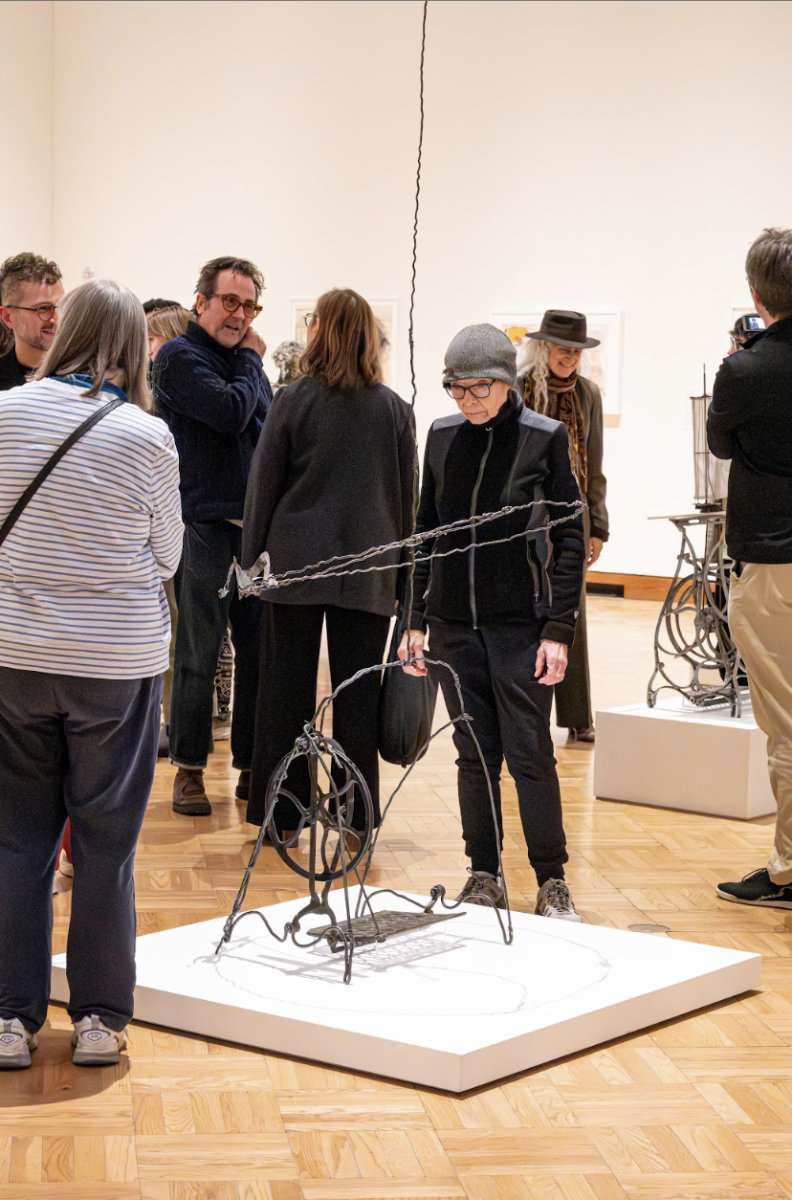
On March 5, the Allen Memorial Art Museum hosted “The Mesh in the Mess,” an Allen After Hours event collaborating with Professor of Dance Ann Cooper Albright to interpret and honor the work of visual artist June Leaf through performance. June Leaf (1929–2024) was a Chicago-born painter and sculptor whose exhibition “Shooting From the Heart” is currently on display in the Allen’s Ellen Johnson gallery. “Mesh in the Mess” stands out as an interpretation and representation of one of Leaf’s biggest inspirations: dance.
As part of her Practice as Research/Research as Practice class, Albright and her students composed a dance and spoken word performance that took place in the King Sculpture Court.
In Albright’s class, students were assigned readings about museum curation and performing arts in museums. They then went on a tour of the June Leaf exhibition with Sam Adams, curator of modern and contemporary art, and each chose a work that they were interested in to research and present at the event. After two brief rehearsals, they performed at the museum to a crowd of about 150 people.
“[June Leaf’s] fervor for exploring the same idea in many different ways is very inspiring to me,” College third-year Ozzie Frazier, a Practice as Research/Research as Practice student, said. “As a dancer, it’s really unique to see a studio artist whose experience and whose practice is, to them, a dance. It was also really inspiring to come into the museum and ask, ‘How do we get people to engage with this work the way that she wanted them to see it? How do we get them to engage their bodies, which is not something that [you] often do when [you] go to a museum?’”
Drawing on Leaf’s quotes about her work and themes of tactility, the performance began with Albright walking in circles in the middle of the vaulted room, gesturing to her body and repeating the phrase, “Head, heart, hands.” On the second-floor balcony, dance students looked down at the crowd, whispering to create a compounding acoustic effect that filled the space.
After Albright danced and spoke about Leaf’s artistic philosophy, the dance students descended from the second floor and stood in a circle around the audience, each saying, “Look over here,” and performing an isolated movement inspired by one of Leaf’s pieces. At one point, Albright discussed Leaf’s “Monument to Women” idea as the dancers crawled on the ground toward her.
“When I can make a performance [where I can channel] an artist through my body, then I feel really free,” Albright said. “It’s fun. And I think this was also a good [way] for the students to understand you [can] put something like that together quickly. It really isn’t about the artist seeking inspiration, that kind of modernist myth of the individual, but it’s more like, ‘Hey, let’s put a piece together, shall we?’”
There are limitations inherent in performing in an art museum. Students had to keep a set distance from art pieces and be careful with their movements. Despite this, Albright and Adams stress the importance of incorporating the performing arts into spaces typically set aside for fine arts.
“It’s so important for performing arts students pedagogically to have the experience not just of performing in black box theaters or stages, but of performing in a non-traditional venue,” Adams said.
After the performance, the students divided the crowd into groups and brought everyone into the gallery to discuss their favorite pieces. For the next half hour, community members, staff, and students engaged with Leaf’s pieces together and discussed them in the galleries. Adams and AMAM Coordinator of Student and Community Connection Alyssa Traster worked together to organize the event.
“I really enjoyed how those students activated the museum literally from top — the second floor — into individual works of art [at the bottom],” Traster said. “I’m thinking about how we can achieve that in different ways. This exact format won’t be able to happen all the time, but how can we take those key elements and try to figure out a way to creatively engage people going forward?”
As part of the Allen’s Strategic Plan, unveiled in 2023, the museum aims to make its work more accessible and meaningful for its visitors. Traster mentioned that achieving this goal has included a lot more experimentation with different events and pushing the boundaries of the space itself. The “Mesh in the Mess” event is just one example of a larger push to bring the College, the City, and the broader Lorain County community together at the museum. Grafton resident Kevin Nash saw “Mesh in the Mess” on the campus event calendar.
“The performance was very unique,” Nash said. “I like the mechanical things [in June Leaf’s sculptures]. Those are really interesting. Some of the paintings were very chaotic and loud and noisy and fun to contemplate. Overall, [it was] a good experience.”
Community member and Office of Disability and Access Departmental Assistant Carmen Ramirez McFarlin heard about the event through Adams’ Instagram account.
“What I like [about June Leaf] is that she knew how she had to be in the world,” McFarlin said. “I loved her perspective on feminism being [an] entity — that if it got big enough, it could tell men ‘Shut up’. Not just ‘Shut up’, but to listen and pay attention. I love giving space to an older, strong, rough woman. … I think the performance was important to tie in movement and dance and having a physical response and inviting viewers to do the same because that’s what June was about.”
“June Leaf: Shooting From the Heart” will be at the Allen through May 24. Until then, the museum is hosting Object Talks and a Tuesday Tea, both of which will discuss the unconventional artist’s work further.


