

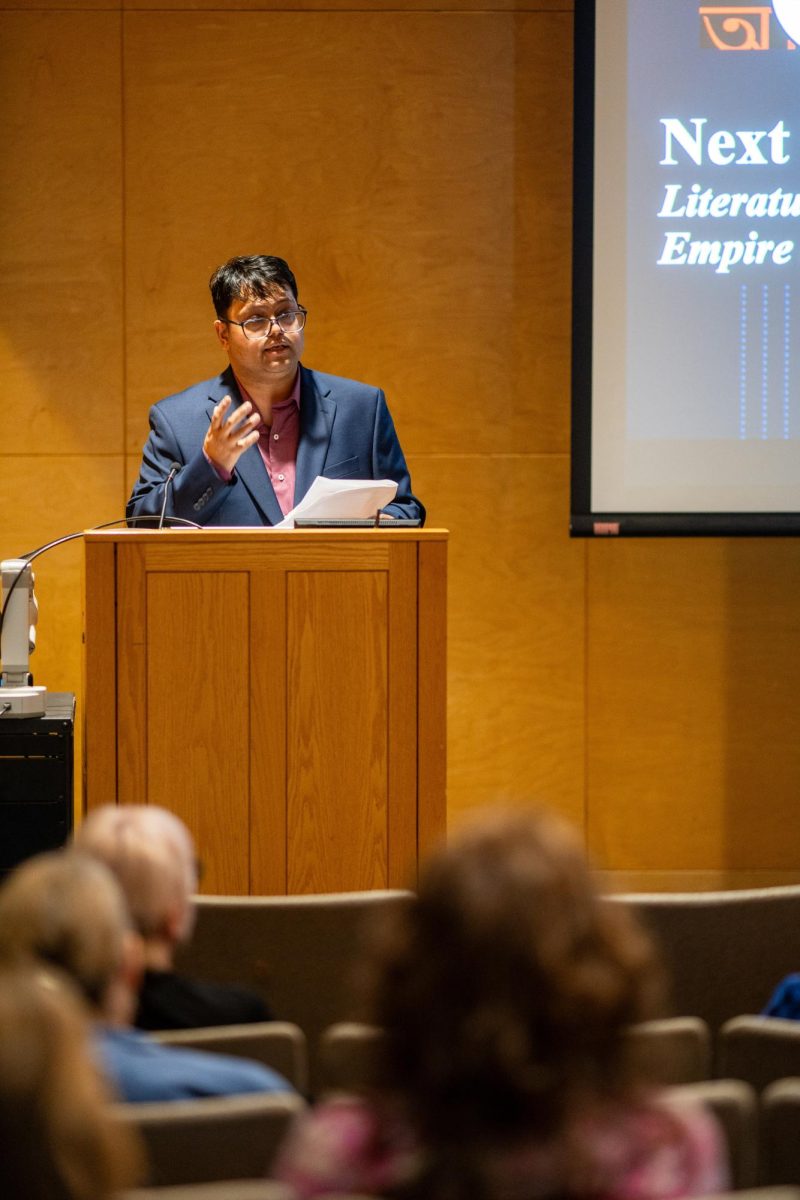
The history of Bangladesh’s statehood, achieved in the 1971 Liberation War, is long and tumultuous. On April 3, three Bangladeshi professors — Visiting Professor of English and Mellon Postdoctoral Fellow in Postcolonial World Literature Asif Iqbal; Columbia University Associate Professor of Visual Arts Naeem Mohaiemen, OC ’93; and UC Berkeley Professor of Gender and Women’s Studies and Global Studies Elora Shehabuddin — delved into this tangled background, exploring the country’s complicated experiences during the 20th century.
The lecture, “Churning of History: The Bangladesh Story,” was a part of the English department’s Bongiorno Lecture Series. English and Economics Administrative Assistant Patty Kishman worked behind the scenes to make this event happen, while Iqbal cultivated the topic and speakers.
All of the lectures centered around Bangladesh’s history, specifically the 1947 partition of India and the 1971 Liberation War, where East Pakistan, thereafter Bangladesh, gained its independence. Iqbal began the talk by discussing his recently published book, Bangladesh in Anglophone and Vernacular Literature: Cultural Imaginings of a Postcolonial Nation.
“I introduced the book as a major intervention in postcolonial literary studies,” he said. “In particular, [it’s for] folks working with partition studies and South Asian studies, where there was a need to engage Bangladeshi literature.”
In his book, Iqbal examines three historical junctures: the 1947 Partition of India, the period when Bangladesh was referred to as East Pakistan from 1947–1970, and the Liberation War of 1971. He argues that studying these three historical junctures is key to understanding Bangladesh.
Iqbal studies two types of literature: the vernacular and the anglophone. He explained that vernacular literature traces back to colonial Bengal, while anglophone literature is a more modern development.
“Modern Bengali literature has a direct link to Western culture,” he said. “[It connects to] not only colonization, but Western ideas, liberalism, so on and so forth.”
Iqbal said he mainly examined literature from 1950 to 2014 for his book. He studies popular writers in the West, such as Salman Rushdie and Jhumpa Lahiri, and places their work in conversation with other British Bangladeshi writers, including Zia Haider Rahman, Kamila Shamsie, and Amitav Ghosh. However, he also involves Bangladeshi writers whose work is not as well-known.
“It is a study of the nation, and without studying those literatures, it would not be possible to make sense of it,” he said.
Mohaiemen’s three-screen video installation, Through a Mirror, Darkly, is on view at the Wexner Center for the Arts at Ohio State University until August, 2026. His work has been shown at many museums, notably the MoMA, Tate Modern, and the Art Institute of Chicago.
He returned to Oberlin, his alma mater, to give a talk on the July Uprising, Bangladeshi women, and the uprooting of old statues. His presentation style illustrated his award-winning film background; he spoke to the audience in a poetic style, working with powerful images onscreen.
Mohaiemen quoted political theorist Hannah Arendt and her belief that the most radical person during a revolution will become conservative the day after. He discussed how women were made to seem like the forefront of the movement behind the July Uprising, only to be quickly pushed aside once the uprising was over. Like Professor Iqbal, he puts political theory and real political events — ones that were likely overlooked outside of Bangladesh — in conversation with each other.
Shehabuddin closed out the lecture with an overview of her book, Sisters in the Mirror: A History of Muslim Women and the Global Politics of Feminism. In it, she challenges assumptions about a lack of feminism in the Muslim world. She examines both Muslim and Western feminist literature dating back several centuries, arguing that feminist movements in Western and Muslim communities have developed in tandem. She mentioned Muslim feminists Karimunnesa Khanam Chaudhurani, Begum Rokeya, Razia Khatun Chaudhurani, and Nurjahan Begum.
She highlighted how both Western and Muslim societies have their own history of indigenous and authentic feminism, stating that when Muslim women advocate for their rights, they have to operate in the shadow of Western imperialism.
Shehabuddin gave the example of how Mary Wollstonecraft used Muslim women’s supposed lack of rights to argue for English women’s rights in “A Vindication of the Rights of Women.” She then talked about Mirza Abu Taleb Khan, a 19th-century scholar and traveler who wrote, “Vindication of the Liberties of Asiatic Women,” in response to Wollstonecraft’s criticism of Muslim women’s rights.
Shehabuddin said that stories of conflict, racism, and colonialism are also stories of people reexamining their own selves. She discussed how Muslims in Bengal have been neglected in the histories of South Asian Muslims. She also emphasized the urgent need for discussion across borders and how no one has a monopoly over an idea.
It was a very enlightening event, with all three lecturers telling underrepresented stories of Bangladesh. Iqbal, Mohaiemen, and Shehabuddin put Western reductions of history in conversation with Bangladeshi stories and truths, bringing postcolonial research to Oberlin in this lecture that had been in the works since last spring.
“[It’s rare when] Bangladesh becomes highlighted in a U.S. campus,” Iqbal said. “Otherwise, there isn’t a lot of conversation. [It’s good to] talk about Bangladesh in all its complexities, including its literary cultures, which are very rich.”


