

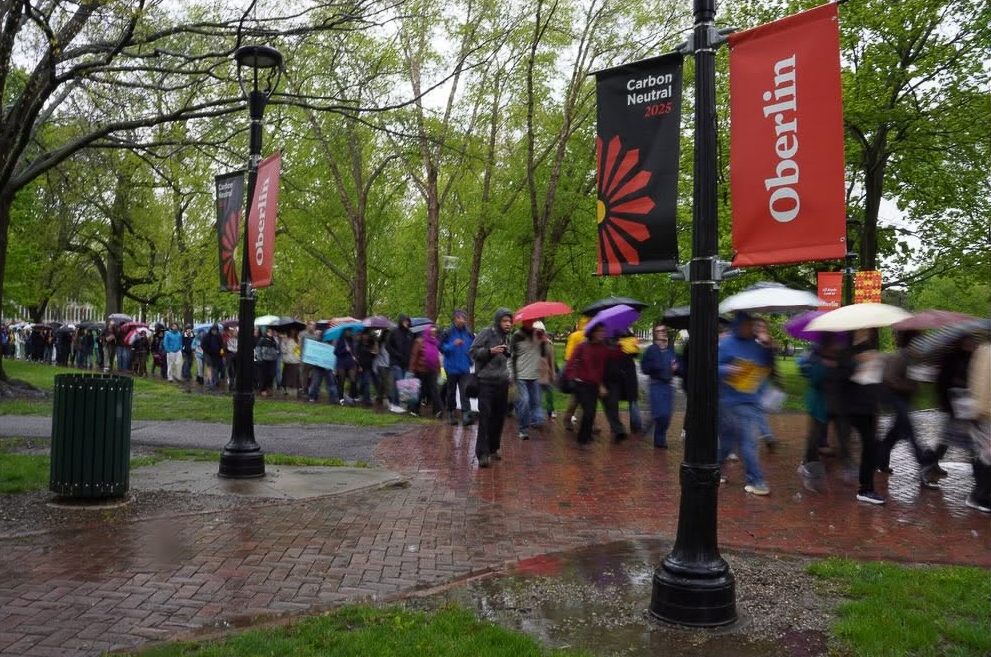
On Friday, May 1, many students skipped class in honor of International Workers’ Day to attend teach-ins, discussions, and art events, and to stage a march around campus. Over 100 people gathered in the cold rain in front of Wilder Hall, then marched in a meandering path around campus leading to the Tappan Square bandstand, where they listened to speeches from organizers.
The day of protest came as over 500 unions, student groups, and other organizations across the country mobilized against economic and political inequality. An umbrella organization, May Day Strong, called on Americans to skip work or school and not patronize businesses, and sponsored over 5,000 events across the country.
The Oberlin events were organized by a coalition of student organizations, led by the Oberlin chapter of Ohio Student Association and the Oberlin Climate Coalition.
“We reached out basically to any org … that we thought would be interested in getting involved,” College second-year and OSA President Coby Kramarsky said. “Out of that, certain leaders rose up, and certain people took charge. So, how we ended up with the core partnership of OSA and the Climate Coalition was just that the people who were the most interested and most active in organizing were coming from those orgs.”
The organizations involved represented diverse causes and concerns. Covid Safe Oberlin held a discussion on caring for disabled people, Students for Energy Justice tabled regarding the City of Oberlin’s controversial plan to install natural gas to its future industrial park, the Oberlin chapter of the American Civil Liberties Union held a teach-in on reproductive rights, and Oberlin Student Cooperative Association held a teach-in on classism at Oberlin.
“I think what connects all of these issues is that we currently live in a system that is controlled by a small and powerful elite of billionaires and conservatives, and they have a lot of opinions about the way that things should be run, and they don’t really listen to the opinions of students or workers or … the lower class,” Kramarsky said.
OSA connected Oberlin organizers to May Day activities at other schools, according to Kramarsky. The Ohio Student Association emerged in the wake of the Occupy Wall Street movement and now has 12 chapters at private and public schools across the state. OSA was important in organizing May Day events in Ohio, and connected Oberlin organizers to Students Rise Up, the student section of May Day Action. In late January, OSA Chapter Presidents Kramarsky and College second-year Mikinzi Allen traveled to Orlando, FL in late January for the Students Rise Up convention, where they met with organizers from schools across the country.
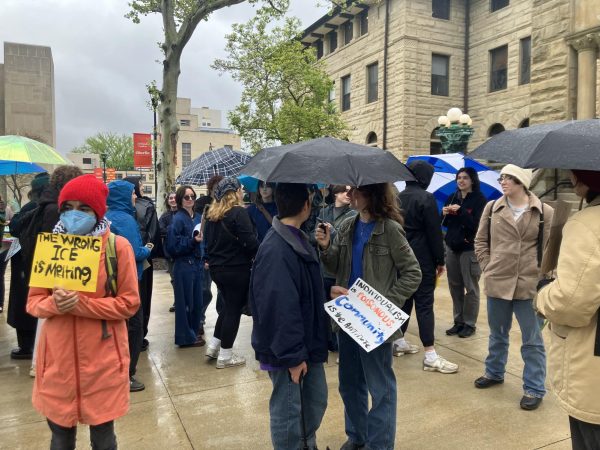
OCC led the walkout march; however, the chants, songs, and speeches did not solely focus on climate issues. Speakers from OCC and OSA spoke about immigration enforcement and cuts to Supplemental Nutrition Assistance Program, Medicaid, and other federal programs, and voiced opposition to the Trump administration and corporate America in general.
“We are a group modeled after the National Sunrise movement, where climate justice is fighting authoritarianism,” College fourth-year and OCC member Luke Moeller said. “We’ve seen this with Sunrise being involved against the Operation Metro surge in the Twin Cities. Migrant justice and fighting ICE is climate justice. We need to have a livable future, and a livable future is one where authoritarianism does not prevail.”
Most of the crowd were students, though some community members were in attendance. In particular, a group of volunteers in blue vests was present. Lili Sandler, an Oberlin resident and the founder of the progressive organization Lorain County Rising, said she had organized these “safety marshals” on behalf of student organizers. She also helped find a sound system to lend to students for speeches.
“Oberlin has a long and beautiful history of politically active students, and I think it draws a lot of the students here,” Sandler said. “Older community members are like, ‘I remember when I did that’, and so it makes them feel good to see young people getting involved in that way.’”
College second-year Julian Gorn, who attended the march, said he appreciated the participation of community members.
“I think that with Oberlin, it’s easy to get into this intellectual … bubble where you’re so disconnected from the real world and everything’s just through this very specific lens,” he said. “I think these kinds of events, where the outside community and Oberlin students come together to protest, are very important.”
In speeches throughout the event, organizers emphasized the power of grassroots organizing to effect change.
“The goal of May Day was to show that we can shut down the system,” Kramarsky said. “We can shut down the country [or] an institution like a college. We can shut down these institutions as people who are feeling the effects of these [institutions] but not in power.”
Moeller also said combined actions by individuals could have a big impact.
“This is a moment in history when we need to do our part,” he said. “It can be as small as choosing to boycott one specific corporation and cutting that out of your life. It can be as small as calling a representative once a week. And those are small things that are big because everybody is doing them, and they get sustained over time.”


