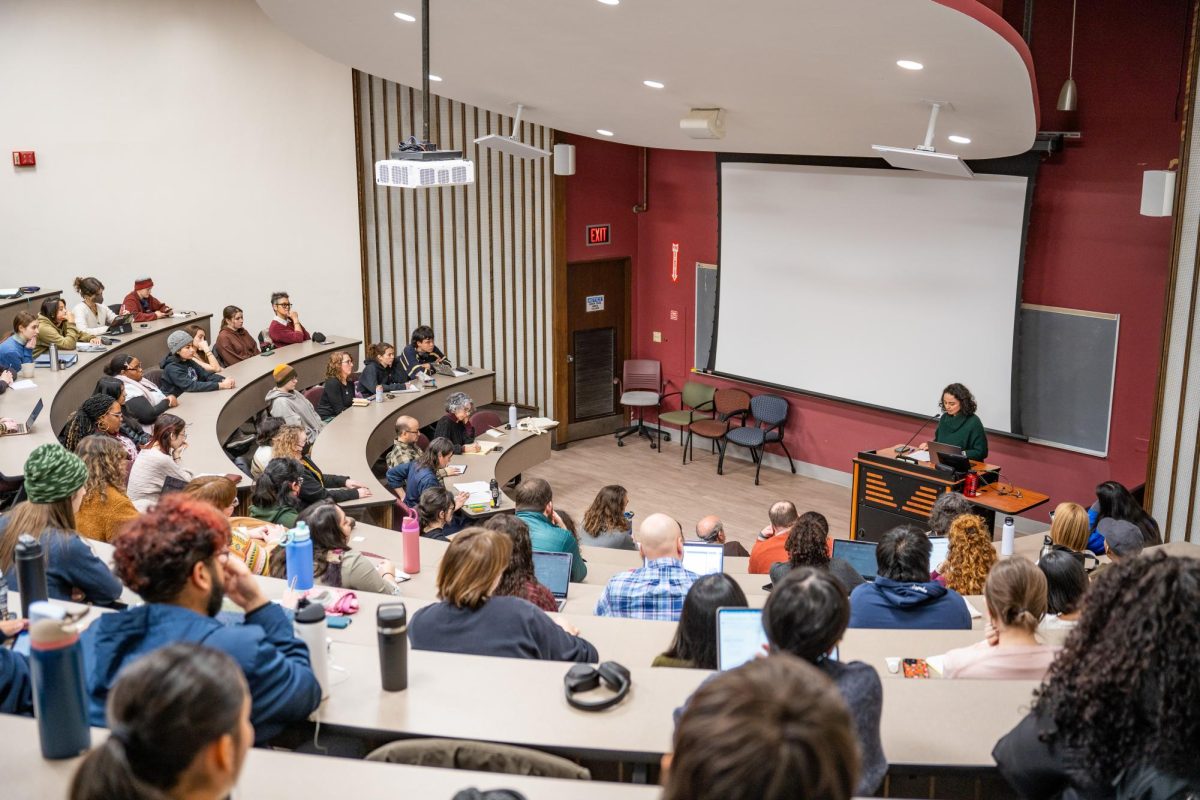
Not long after 12:20 p.m. on Thursday, every seat in King 106 was filled by attendees for a teach-in titled, “Maduro, Militarization, and a New World Order?” Professors from the Comparative American Studies, Hispanic Studies, Africana Studies, Politics, History, and Anthropology departments came together to analyze different aspects of the recent U.S. intervention in Venezuela.
The teach-in comes in response to the capture of Venezuela’s president, Nicolás Maduro. On Jan. 3, U.S. military personnel removed President Maduro from the Fuerte Tiuna military site. Maduro has since been brought to the U.S., where he has been indicted in New York’s Southern District on charges related to drug commerce, terrorism, and weapons possession. The operation to capture Maduro followed months of hostility toward Venezuela from the U.S., including attacks on 38 boats.
Professor and Chair of Comparative American Studies Gina Pérez introduced the event.
“I started thinking that it would be really great to bring the expertise of my colleagues together to have a conversation about this,” Pérez said. “[It] obviously has implications for Venezuela, but it [also] has implications for Colombia and throughout the Americas, and as we’ve seen, has broader global implications about the increased militarized approach to U.S. foreign policy.”
In an interview prior to the event, Pérez said she saw links between the attack in Venezuela and the actions of immigration authorities in the U.S. She recalled sociologist C. Wright Mills’ warning that posing issues in a way that invoked the military would lead to solutions that did the same.
“When we think of immigration in militarized terms and then justify billions of dollars to ICE and to Homeland Security to spearhead this immigration enforcement that’s highly militarized, the use of militarized force in U.S. diplomacy, in Latin America as well as Europe and the Middle East. … I see these as deeply interconnected,” Pérez said.
The teach-in began with Professor of History Emeritus Steven Volk reviewing the history of U.S. foreign policy in the Caribbean and the version of the Monroe Doctrine currently employed by President Trump. Following Volk, Chair of Hispanic Studies and Eric and Jane Nord Associate Professor and Chair of Hispanic Studies Ana María Díaz Burgos discussed how relations between Venezuela and Colombia have changed over time. Professor of Anthropology and Latin American Studies Baron Pineda reflected on the way in which the Trump administration had shown a disregard for human rights and international law, with a focus on the removal of Venezuelan-born U.S. residents to the Terrorism Confinement Center or CECOT in El Salvador.
Professor of Politics Kristina Mani examined the United States’ reliance on military action in its foreign policy. Speaking to the Review prior to the event, she suggested that, alongside seeking to deter Venezuelan immigration to the U.S. and other motivations, the Trump administration’s actions in Venezuela stemmed from a desire to weaken Cuba.
“It’s the oil supplies from Venezuela, going to Cuba, that have helped to sustain the Cuban regime,” Mani said. “[The Cuban regime is] the longest-standing thorn in the side of a particular faction of the U.S. foreign policy community. The U.S. has tried virtually every possible means to … destabilize the regime, and it hasn’t worked.”
According to Mani, Venezuela took over as Cuba’s main supporter after the collapse of the Soviet Union — a position that the incursion on the country has negated.
Following Mani, Professor of Hispanic Studies and Program Director of Latin American Studies Sebastiaan Faber discussed the latest National Security Strategy issued by the Trump administration. Finally, Visiting Assistant Professor of Politics Amanda Zadorian refuted the prevailing notion that the incursion in Venezuela was motivated by a desire on the part of the U.S. to control the country’s oil.
Volk remarked on how college campuses are ideal places for facilitating awareness through events like this teach-in.
“We’re made for this,” Volk said. “This is what colleges are about.”