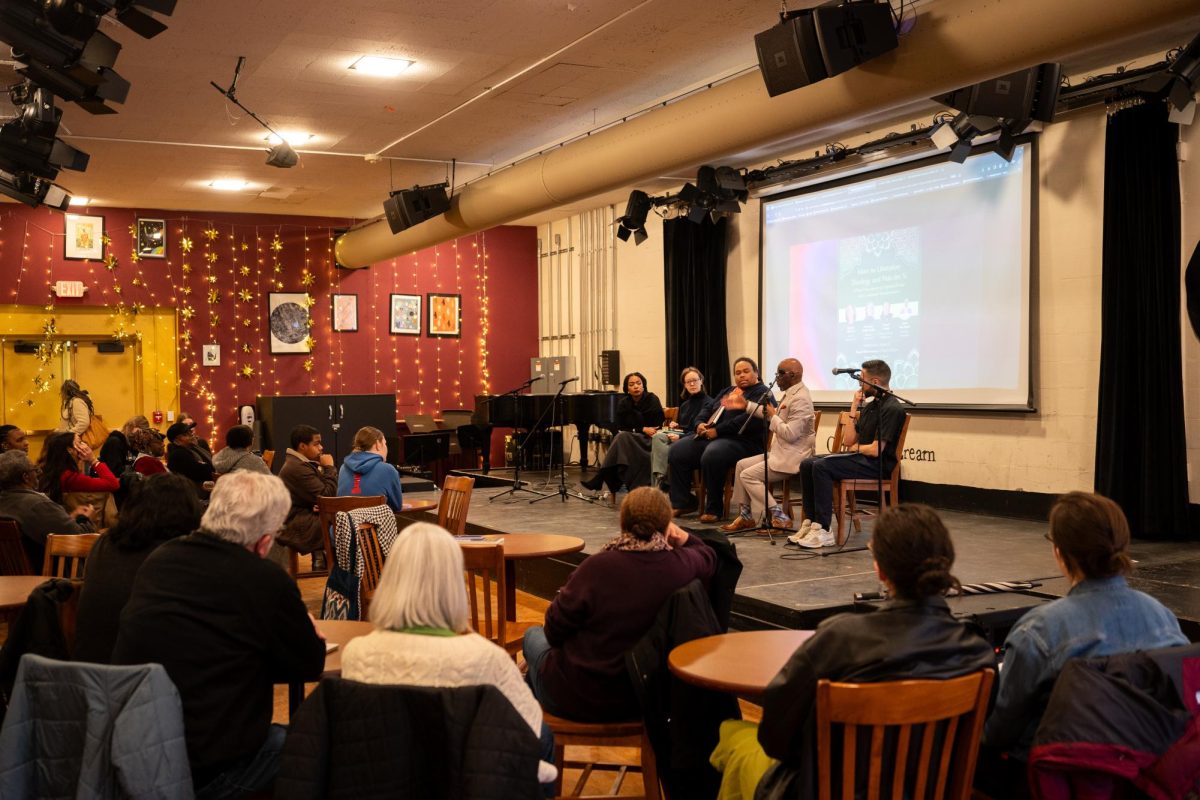
On Wednesday afternoon, nearly every seat in the Cat in the Cream was filled with attendees of “Islam as Liberation Theology and Malcolm X: A Panel Discussion on Spiritual Praxis and Communal Transformation.” Four speakers — President of the Lorain Interfaith Association Imam Paul Hasan, Visiting Assistant Professor of Islamic Studies Francesca Chubb-Confer, Assistant Professor of Africana Studies Everett Hardy, and author Aaliyah Bilal, OC ’04, — gathered to discuss the life and work of Malcolm X, as well as the work of the Nation of Islam, a Black Nationalist and Muslim organization that Malcolm X was a part for most of his life.
The event was organized by Outreach and Student Success Librarian Alonso Avila, who originally planned to create a display featuring books written by or about Black American Muslims in Mary Church Terrell Main Library. According to College fourth-year Juwayria Zahurullah, Avila had reached out to her to involve the Muslim Student Association with the panel. Zahurullah said that the project was in recognition of both Ramadan and Black History Month, which take place during February this year. However, after encountering difficulty connecting the display’s theme with existing library exhibitions, Avila shifted the plan to a panel discussion at the suggestion of Chubb-Confer.
“Growing up, talks about Islam tended to focus more on the Middle East and South Asia,” Avila said. “Knowing that enslaved Africans brought with them Islam to the Americas, that’s already saying a lot. And so I think that we need to go back to that story and remember that Islam was here in the United States from its foundation and that Islam doesn’t just necessarily have to come from the Middle East.”
Zahurullah, who attended the discussion, offered similar thoughts during an interview before the panel began.
“Black American Muslim scholarship is something that’s often overlooked and ignored in greater American Muslim conversations,” Zahurullah said.“It really is Black American Muslim thought that has paved the way for Islam to become more accepted in America, so I think it’s very important within Muslim circles, but also generally as Americans, that we recognize all of that history and that scholarship.”
Hasan started the evening by describing the development of the particular form of Islam espoused by the Nation of Islam, as well as his own path toward becoming a member of the organization. Hardy further outlined the ways in which the Nation’s teachings were freeing for those who received them — Black Americans participating in the Second Great Migration — before tracing the trajectory of Malcolm X’s involvement with the group.
The Nation of Islam is not universally viewed in a positive light: The Southern Poverty Law Center considers the organization to be a hate group for its many homophobic and antisemitic beliefs. In an interview prior to the event, though, Hardy offered a more complicated view.
“I had a conversation about this once in college with someone who was saying … ‘Well, the Nation is anti-LGBTQIA. It’s anti-Jewish, and so this is a reason that Black people should divest from the Nation of Islam,’” Hardy said. “And the counter to that was, ‘Well, yes, [NOI leader Louis] Farrakhan has espoused those views, but the Nation of Islam is also in Black communities, right now, doing work with Black boys and Black girls that other groups are not. So who’s going to step into that space?”
Following Hardy, Chubb-Confer discussed Malcolm X’s journey to Mecca in 1964 and the multinational perspective it gave to his thinking about the fight for Black people’s rights in the U.S.
“He comes to understand his struggle, and Black Americans’ struggle, as part of this bigger international logic of anti-imperialist, anti-colonial struggle,” Chubb-Confer said.
After Chubb-Confer’s segment, Bilal, author of the short story collection Temple Folk, which takes former members of the Nation of Islam as its characters, recounted her memories of her paternal grandfather, a member of the Nation of Islam. Bilal described her grandfather’s life and the path he took to joining the Nation, alongside his wife and several of her siblings. She referenced the abuse her family members suffered while attending the University of Islam, a Nation of Islam-administered school, and recalled a story of Malcolm X visiting her great-grandmother at her home.
“I’m really proud of my family’s story, and I like the ways that my family’s story can help illuminate aspects and corners of American history that are typically only discussed in academic, sort of theoretical literature,” Bilal said.
The event concluded with an iftar for those in attendance.