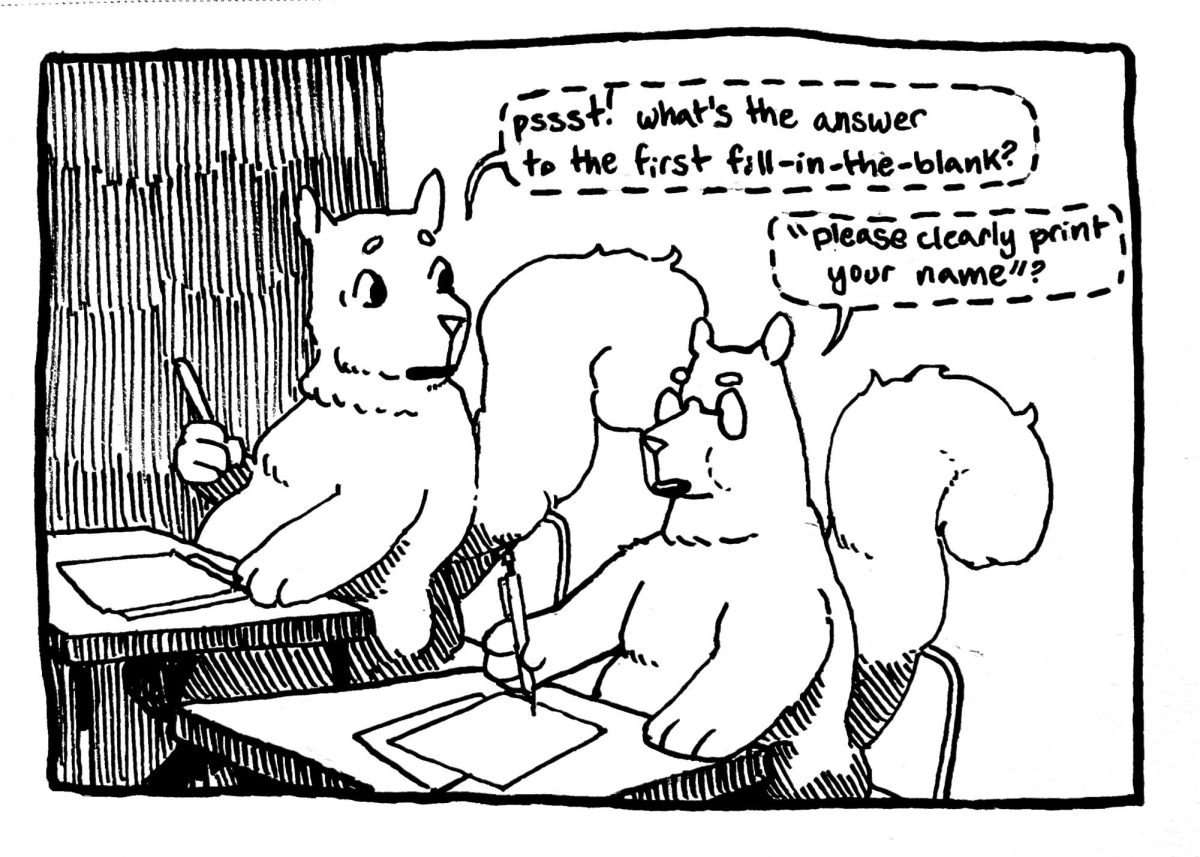
I took my first in-person midterm exam at Oberlin a few weeks ago. I came prepared with the testing etiquette ingrained in me since high school: Don’t open my packet until everyone gets theirs, keep my phone zipped in my backpack, and my eyes squarely on my own paper. I have been taught how to avoid any habit that resembles the mere possibility of cheating. I was surprised, then, when my professor handed off the last test packet and walked straight out of the lecture hall. We were free to take the test on our own, free from the pressure of surveilling eyes at the front of the room. The only semblance of obligation not to cheat was the standard signature on the back of the test: “I have adhered to the Honor Code in this assignment. “
Oberlin faculty regularly emphasize the importance of academic integrity. Many of my writing-intensive classes have begun with long discussions of AI usage and plagiarism. Signing the honor pledge exemplifies the importance of honesty in every assignment, as forgetting to sign can put a student at risk of a failing grade. For an institution with such thorough standards regarding integrity, I was surprised to learn that all major exams are either take-home or un-proctored. Oberlin’s commitmet to academic integrity appears to be more symbolic than practical, with few functional measures in place to identify and report actual breaches of the Honor Code.
When cheating is reported, the case is sent to a student committee, which holds a hearing and deals out sanctions. These consequences can be small, like an official warning or a letter of apology, or they can become quite serious — like suspension from school grounds. Any sanction beyond a warning can appear on a student’s academic record, which is visible to third parties like graduate schools or employers. When punishments for academic misconduct can become so severe so quickly, it is important that cheating is identified as thoroughly and fairly as possible. As our Honor Code stands now, I do not believe that this is possible.
The document states that, above faculty responsibility, “students bear the responsibility of ensuring the maintenance of academic freedom in the community and reporting possible infractions.” More specifically, students must dissuade their peers from breaking the Honor Code, report any incident of dishonesty that they are aware of, and self-report if they themselves violate the Code. The document also declares that professors must not be present for in-person exams, as the obligation to act honorably rests entirely in the hands of the students.
Though I am accustomed to tighter surveillance and accountability from high school, I must acknowledge the merits of an honor system built on the integrity of students instead of the teachers’ distrust in them. It is a privilege to be trusted to act like honorable adults. However, the unfortunate reality is that college students still cheat. It is important, then, to ensure that the system we have in place actually keeps students accountable.
As the system is currently set up, I believe that the majority of cheating cases go unreported. It is unrealistic to expect students to report their own violations, and I have very little faith that peers would report each other. I know I wouldn’t report a classmate for cheating, even if we were strangers. Unless a class grade is heavily curved, students have no motivation to report others. More likely, they would be discouraged from action by the knowledge that they’re putting another classmate in serious jeopardy.
One study from the International Center for Academic Integrity, which polled 840 students across different college campuses, found that about 32 percent of undergraduate students have cheated in some way on a college exam. On our side of the equation, a statistic from a 2015 article in The Oberlin Review found that only one in 60 students — about 1.6 percent of the student population — was reported for cheating (“The Honor Code,” The Oberlin Review, Feb. 13, 2015). This is, admittedly, an old statistic. However, the language around student reporting and test proctoring has not changed since at least the 2008 version of the Oberlin Honor Code. We may assume from the unchanged reporting policy that rates have remained fairly stable.
If we are to trust these statistics as fair representations of our current student population, we can estimate that only around 5 percent of Oberlin’s total academic honesty violations are reported each year. The rates of reporting could have changed since 2015, and the national study from the ICAI may not be representative of a small campus like Oberlin. Still, this estimate points to the extremely likely case that cheating is vastly underreported on campus.
Perhaps if cheating does not impact other students, underreporting is not a major issue. Those who aren’t caught cheating still face punishments; they forgo learning skills that they likely spent tens of thousands of dollars to learn. However, the current system is unfair to the students who do get caught. Their punishment, which can be severe, is disproportionate to all of the other students who cheat and face no repercussions for their future educational or employment prospects.
If Oberlin wishes to uphold its own standard of academic honesty and freedom, there must be stronger systems in place to ensure that cheating is identified consistently and fairly. We should, for instance, allow instructors to remain in their classrooms and supervise students during exams. During a time in which AI and the internet can provide answers instantaneously and almost invisibly, keeping a supervisor in the room is not an unreasonable violation of student trust. Allowing professors to take basic precautions instead of relying on peer reporting would promote the culture of integrity and accountability that the Honor Code strives to establish.