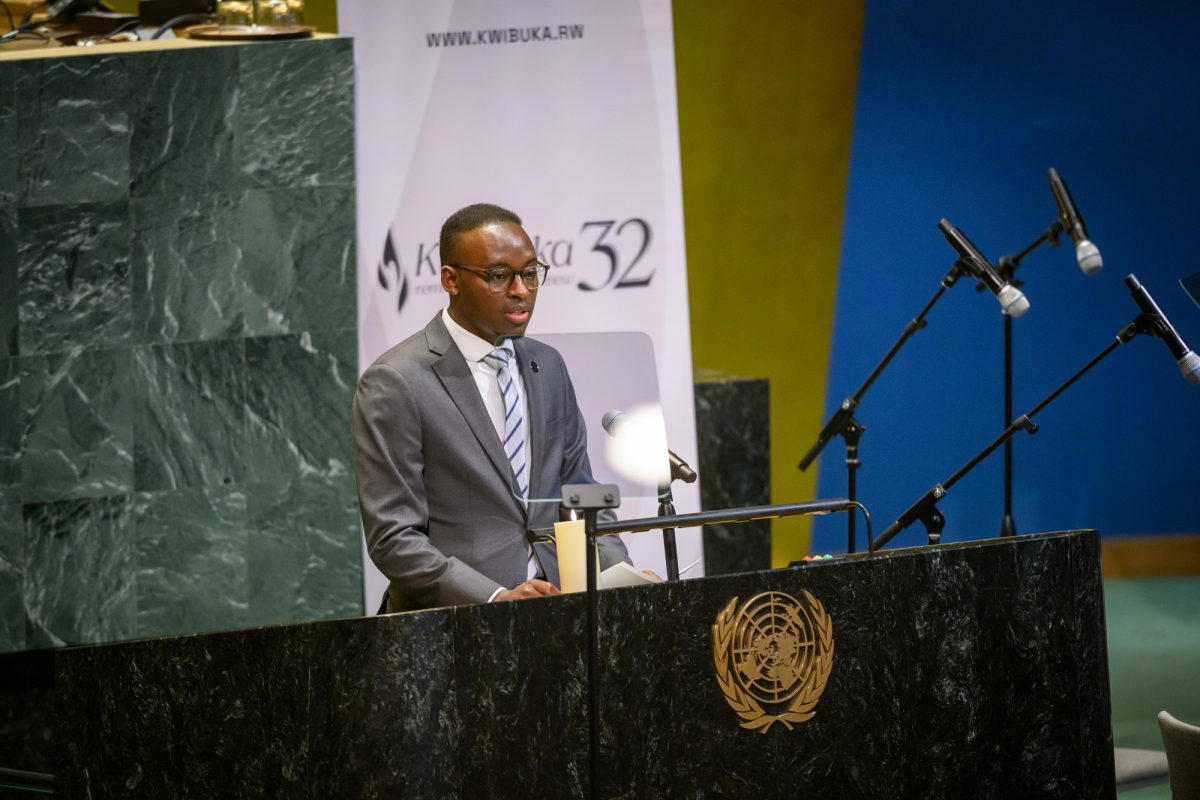
On April 6, Oberlin’s Chief Information Officer Marcel Mutsindashyaka traveled to New York City to address the United Nations for the International Day of Reflection on the 1994 genocide against the Tutsi in Rwanda. Mutsindashyaka spoke to the gathering of officials and survivors as president of Ibuka USA, an advocacy group led by Rwandan genocide survivors living in the U.S.
The genocide occurred in 1994, when Mutsindashyaka was five years old. Within 100 days, Hutu militias murdered over 800,000 people, most of whom were ethnic Tutsi. Twenty-seven members of Mutsindashyaka’s family were killed, including his father, two brothers, and a sister.
Mutsindashyaka was introduced by U.N. Under-Secretary-General for Global Communication Melissa Fleming, OC ’86. His address called on the international community to support genocide survivors, address anti-Tutsi prejudice still prevalent in the region surrounding Rwanda, and continue to seek justice against those who perpetrated the genocide.
“Today I speak on behalf of survivors, those who endured unimaginable loss and chose to rebuild their lives with dignity,” Mutsindashyaka said in his speech. “I carry a responsibility to more than a million lives that were silenced.”
Mutsindashyaka noted that more than half of survivors live with trauma and over one third still endure “severe psychological distress.” He also highlighted material struggles that survivors experience, including “health issues, economic hardship, and aging homes.” He said that the needs of genocide survivors will only grow as they age and become more dependent.
“The government of Rwanda has made tremendous progress in justice, education, healthcare, and housing, which helped us survivors, but these responsibilities should not rest only with Rwanda,” he said. “It should be shared by the international community, because it was watching.”
The inaction of the international community has drawn criticism. A U.N. peacekeeping force was present in Rwanda prior to the genocide, but after the start of the violence, the international body voted to drastically decrease it.
Mutsindashyaka also spoke of a need to continue to seek justice on behalf of survivors. He said justice for the genocide “remains incomplete,” noting that some perpetrators were still free. He praised the work of the International Criminal Tribunal for Rwanda but called for ICTR records to be transferred back to Rwanda for historical preservation.
The genocide left Mutsindashyaka an orphan. He later became a Fulbright Scholar and a Yale World Fellow and founded Umuseke, which a release from Yale University described as Rwanda’s second-most popular news source. He joined Oberlin as chief information officer in the fall of 2022.
Throughout his address, Mutsindashyaka emphasized the resilience of survivors.
“Even after everything we lost, we chose to rebuild,” he said. “We chose life. We chose unity. Some chose forgiveness. We built families, economies and communities. That is the true image of resilience.”