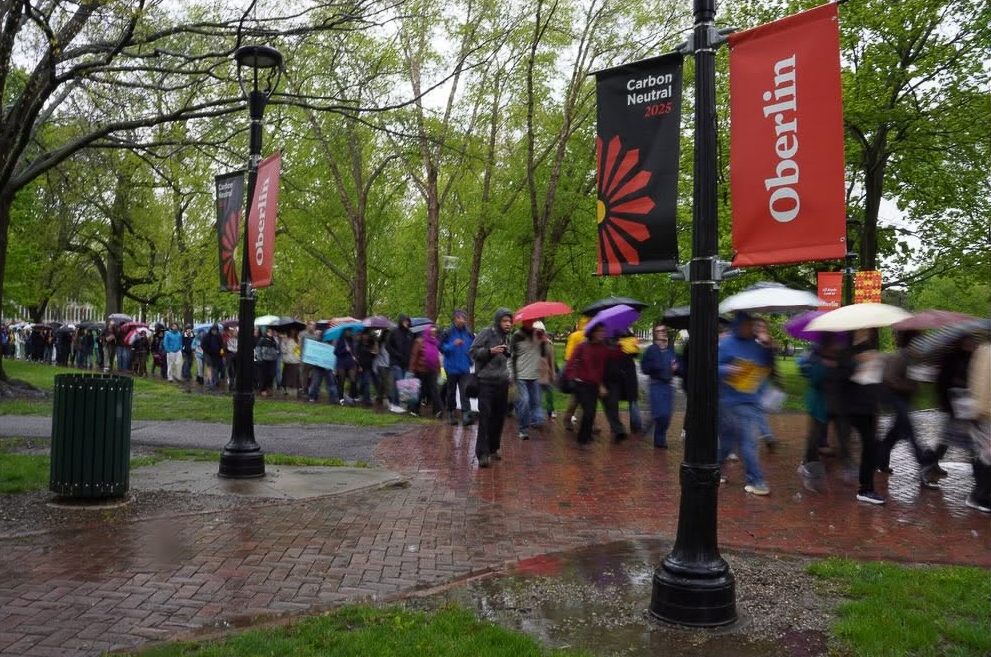
Oberlin’s status as a carbon-neutral campus was verified by the third-party UL Solutions and conveyed to the Office of Energy and Sustainability two weeks ago. In 2006, Oberlin made a commitment to be carbon neutral by 2025, a goal the institution announced that it had achieved last spring and that has now been independently verified.
According to Senior Director of Energy and Sustainability Chris Norman, the verification process required the observation of utility bills, greenhouse gas statements, and commuter and college-sponsored air travel data, as well as other forms of documentation over a one-year period that began in November 2024. UL Solutions also conducted a site visit to directly examine Oberlin’s facilities.
“We had a conversation with Second Nature [Climate Leadership Network], and they indicated that our decarbonization was going to be significantly more than any other campus has done,” Norman said. “I offered that we have a third party review our numbers, and they thought that that would be a great idea just to make sure because we think we’re going to turn some heads.”
Norman said that, against their baseline measurement in 2007, Oberlin has achieved an 86 percent reduction in carbon emissions. A substantial amount of this decarbonization has occurred due to the Sustainable Infrastructure Program, a four-year project to convert the campus from a traditional heating and cooling system to geothermal.
Any carbon still emitted through the burning of natural gas on campus, the College’s vehicle fleet, or college-sponsored air travel is balanced by carbon offsets. Through Second Nature, Oberlin is connected with projects that sequester or destroy as many tons of greenhouse gases as are currently being produced through college activities. By paying for these initiatives, Oberlin maintains its status as a carbon-neutral institution while still emitting low levels of carbon.
College third-year Michelle Chen, who is an OES intern, worked with a team last semester to calculate carbon emissions from college-sponsored air travel.
“We got this file of flight data, and we calculated the carbon emissions for each flight, and then added it all together,” Chen said. “Then we sent it to a third-party verifier to confirm that the work was accurate.”
But Norman noted that even with sponsored air travel and other emission sources, Oberlin’s carbon neutrality status is relatively unreliant on offsets.
Through Second Nature, Oberlin is part of the Climate Leadership Network of other colleges and universities who have all signed a carbon commitment and a resiliency commitment. As part of these two pledges, the institutions are required to set a date for achieving carbon neutrality, create a climate action plan, conduct a resiliency assessment, and form a campus-based climate taskforce. According to Second Nature Senior Manager of Climate Programs Bridget Flynn, Oberlin is a charter signatory member of the Climate Leadership Network. The College signed the pledge under the leadership of President Nancy Dye in 2006.
Flynn also praised Oberlin’s carbon neutrality makeup.
“The extent to which Oberlin has been able to tangibly decarbonize on campus is really impressive and beyond what many other campuses have been able to achieve thus far,” they said.
Now that the College has verified its carbon-neutral status, it can serve as a guide for other institutions hoping to install similar climate-friendly infrastructure. The College hosted campus tours during the Midwest Climate Collaborative’s 2026 Summit, and Norman spoke on a panel in March about decarbonization. Norman said it was important that Oberlin share the lessons they have learned throughout the process with other institutions.
“OES is documenting the lessons learned, using a process that we have found that has really benefited our campus … and which we can share with other campuses, so that they can increase their own likelihood of success.” Norman said.
Flynn added that Oberlin is a model of student engagement with carbon management infrastructure.
“The campus has been pretty inclusive in having students perform internships or participate in research and courses, tours, and really get involved in the decarbonization efforts,” Flynn said.
OES will be hosting a panel on May 12 with representatives from UL Solutions and Second Nature to discuss the carbon-neutral verification with students, staff, and faculty.
Having achieved carbon neutrality, the College is continuing to reduce carbon emissions with the ultimate goal of becoming climate-positive — sequestering more carbon than is produced. While Norman said that the process will undoubtedly be long, he is optimistic for the continued reduction of greenhouse gases at Oberlin.
“It’s less important to me that we are the first [or] that we are the most,” he said. “It’s most important to me that we are verified, that we’re true, that we are transparent, and that we can engage our students and faculty in our ongoing sustainability efforts so that it benefits their academic work.”