At a regular meeting of the Oberlin City Council held Monday, community members and Councilmembers debated a proposed ordinance that could enable future natural gas infrastructure. Ultimately, the Council voted 4–3 to approve the measure after extended discussion.
The ordinance, which centers on amending language in the City’s Community Bill of Rights, clarifies whether natural gas infrastructure can be extended to serve industrial manufacturing in the City’s planned eco-industrial park. While City officials framed the change as a clarification, many community members argued it represents a broader shift in Oberlin’s environmental policy. Some stressed that the proposed change went beyond a simple clarification of legal language. Instead, they argued it altered the original intent of the Community Bill of Rights, which was designed to limit the expansion of fossil fuel infrastructure in the city.
The proposal follows ongoing discussions about whether natural gas should play a role in supporting development at the eco-industrial park, with some officials suggesting it may be necessary to attract businesses and ensure reliable energy access.
Public comment reflected a wide range of perspectives. Several residents emphasized the environmental implications of expanding fossil fuel infrastructure, urging the Council to further explore alternative energy options before making a decision. Concerns were also raised about the global impact of fossil fuel expansion and the importance of maintaining Oberlin’s reputation as a leader in sustainability. Others, however, pointed to the potential economic benefits of allowing natural gas, arguing that access to such infrastructure could help attract businesses and support local employment.
Councilmember Jessa D. New, OC ’01, introduced a motion to postpone the decision during the meeting, but Council ultimately voted to approve the ordinance amending the language in the Community Bill of Rights. Councilmembers New, Libni López, and Joe Waltzer OC ’98 voted against the measure, while Council President Eboni A. Johnson, OC ’97, and Councilmembers Michael McFarlin; Kristin Peterson, OC ’72; and Sondra Miller voted in favor. Any specific plans to install natural gas infrastructure connected to the industrial park will still need to be approved by Council.
New said she did not feel Council had sufficient time to fully discuss the implications of modifying a voter-approved measure.
“I did not feel comfortable changing something that was voted in by the community … without the blessing of the folks who were behind it,” she said.
New added that the decision came after significant public pressure and internal uncertainty.
“I just felt like taking the temperature of the situation called for a pause,” she said. “I didn’t think it was too much to ask for.”
McFarlin and Peterson both said they supported the ordinance because they viewed it as a clarification rather than a policy change. McFarlin said he supported the ordinance in part due to concerns about how the original language could impact small businesses, particularly those that rely on access to existing gas infrastructure. He said the revised language clarifies the ordinance’s intent by preventing broad legal challenges to businesses while maintaining the original focus on limiting large-scale fossil fuel expansion.
“I supported the approval of Ordinance No. 26-22 because I was concerned that the original language opened up the possibility of a challenge by anyone in Oberlin to any business who uses gas,” he wrote in an email to the Review.
However, College third-year Savannah Wright, a member of Students for Energy Justice, sees the ordinance as representing a significant shift in the City’s existing policy. She worries the implications of the change could extend beyond the eco-industrial park.
“I am seriously concerned about the future of the City’s natural gas dependence, because this resolution did not only permit service to the industrial park, but gas distribution pipelines to service other future businesses that come to Oberlin as well,” Wright wrote in an email to the Review.
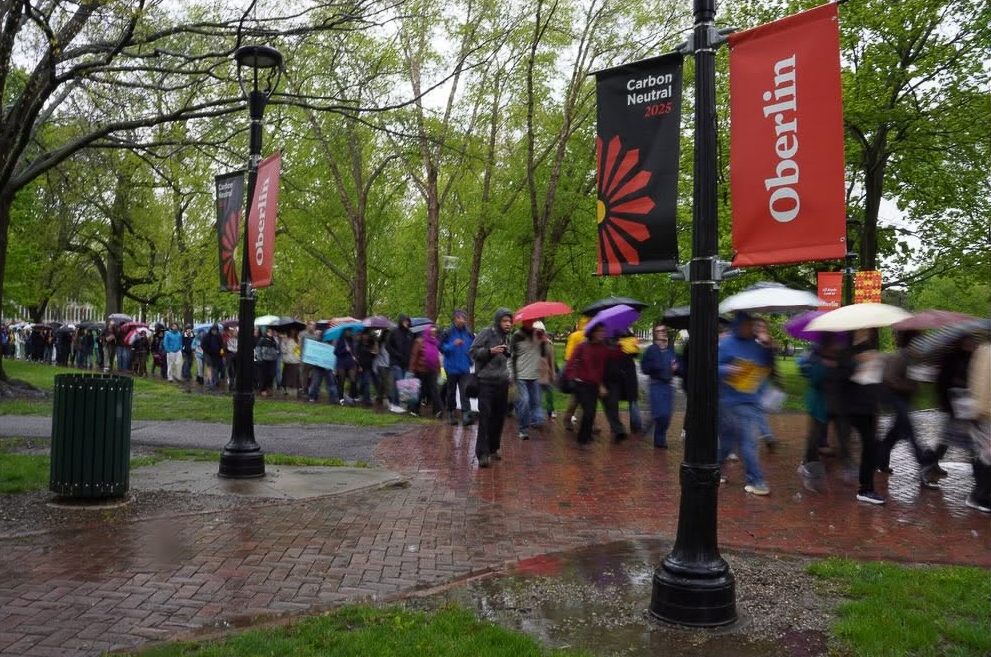
Leading up to the meeting, members of Oberlin Climate Coalition and SEJ organized outreach efforts, including encouraging residents to contact Councilmembers and attend the meeting.
Emma Knisbacher, College first-year and a member of SEJ, emphasized the broader implications of the decision and the importance of community engagement moving forward.
“Bad decisions will be made around us that are going to impact our futures and the futures of this city,” Knisbacher said. “So it’s vital that we take our ideologies, take our progressivism and leftism, put it into action to oppose dangerous resolutions like this in the future and just show City Council and the Oberlin administration that we do care and that we’re willing to show them.”
Specific plans for the new eco-industrial park and its use of natural gas will be deliberated in Council in the coming months.
Peterson said that installing a natural gas connection will not necessarily undermine the goal of an eco-industrial development.
“As I have researched Eco Parks, I have found several eco- friendly businesses that also utilize small natural gas pipelines,” she wrote.