In a Sept. 3 announcement to the Oberlin community, President Carmen Twillie Ambar introduced the Year of AI Exploration at Oberlin, an initiative supported by the President’s Office and divisional deans.
Faculty will lead the initiative with designated advisors from each academic division. Adam Eck, associate professor of Computer Science and Data Science and chair of Data Science, will serve as the College’s director for AI Innovation and Strategy. Joe Lubben, professor of Music Theory, will serve as the Conservatory’s director for the initiative. They will collaborate with campus partners and programs including the Center for Information Technology, the libraries, and the Gertrude B. Lemle Center for Teaching and Scholarship to study AI’s impact on learning, teaching, and research. The findings may inform future policies and curricular developments.
“The goal of this project is not to declare AI as something that is unequivocally good,” President Ambar said. “The goal of this project is to do what I think we do best, which is to apply our academic inquiry and critical thinking skills to this potentially transformational new technology.”
As part of the initiative, all faculty and staff will receive access to the enterprise versions of ChatGPT and Google Gemini in the fall, while students will receive access in the spring. CIT will offer guided AI experiences, likely in four-week segments, for participants to explore tools and build skills. Opportunities will be available to pilot AI tools, including those embedded in existing campus software. A shared internal and public hub will help to centralize this effort, document campus AI activities, support policy development, and enable community knowledge sharing.
Expert-led lectures and conversations on AI will be held throughout the year, as faculty committees work to address AI-related policy, curriculum development, academic integrity, general education, and AI literacy.
Lubben emphasized that his role is primarily as an organizer and advocate. He aims to coordinate programming, bring in outside speakers, and ensure faculty voices are central to the early stages of the project. He also noted that while some Oberlin faculty are already experimenting with generative AI, others are deeply skeptical, and the initiative aims to create space for both perspectives.
“I [want to] gather information from faculty who are using more AI, from faculty who are absolutely opposed to its use, and try to incorporate all of this into an exploration that’s very inclusive and very open-minded,” Lubben said.
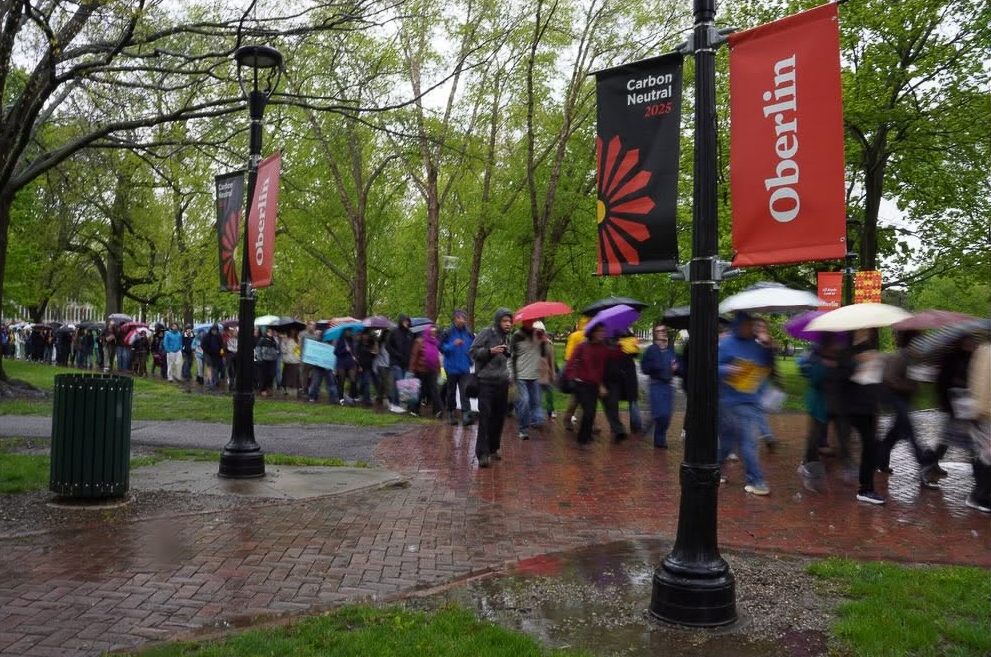
The public announcement highlighted AI’s potential to reshape pedagogy, research, and creative practice at the College and Conservatory. At the same time, President Ambar recognized that Oberlin’s commitments to academic integrity, carbon neutrality, and student well-being present important considerations that may appear to be in conflict with the adoption of new technologies.
“AI’s impact on the environment is a real concern and our students and faculty are the ideal people to work together to find sustainable solutions,” President Ambar said. “But how do we measure our own impact if we don’t have a common tool that everybody’s using? Currently on our campus, everybody is out there using it in all sorts of ways — some using the free versions, some people using the paid version, others not using it at all. So we can’t even think about our own impact if we don’t have a way to think about it collectively. Providing the entire campus with access allows for greater security of our own data and a way to measure our campus usage.”
Lubben stated that the initiative will examine definitions of academic honesty in the context of AI use and explore intellectual property issues in creative fields involving AI, focusing on his role in facilitating conversations for students and faculty within the Conservatory.
Separate surveys are being sent out to faculty in the College and Conservatory this week. These aim to assess different perspectives and ways in which faculty use AI, which will be used to determine the events and discussion organized as part of the yearlong initiative.
“The title of this is [the] Year of Exploration,” Lubben said. “It’s not [the] year of adoption or a year of installation.”
The Review will be covering this initiative and how it will impact different parts of the Oberlin community in greater depth throughout this year.