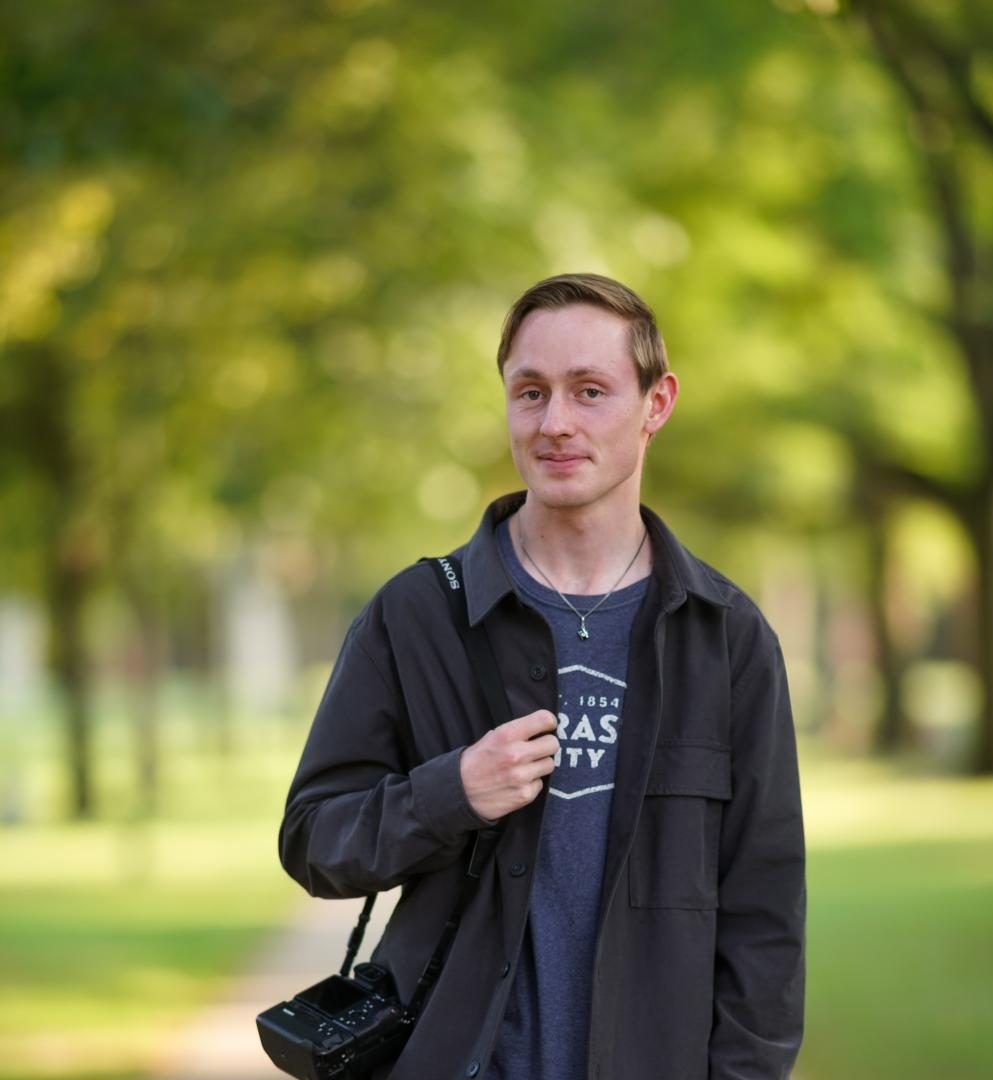
“I have been interested in death since I was a little kid,” Bee Herbstman says. “It’s always been something that’s been weighing on me, [this] consistent weight on my shoulders, is this fear of death that I’ve always had.”
Bee Herbstman, College third-year, leans back in a library swivel chair and looks up at the ceiling before continuing.
“[It’s] the same idea of, like, you’re not scared of the dark, you’re scared of what’s in the dark,” Herbstman said. “I’m not scared of death so much as I’m scared of the idea that it would all be over.”
“Hm,” I say. I’m sitting in another library swivel chair, one that seems to be stuck on the highest level, and my feet don’t quite reach the ground. I look over at my phone, which is lying on the table between Herbstman and me, and quickly say a prayer that it really is recording this interview; it would end up being one of my favorite interviews I had ever done.
“I feel like death has been something that has been lingering around me and making me feel really scared for a long time,” Herbstman continued. “I wonder if it just kind of needed to be talked to and talked about.”
On a rainy Sunday evening, Oberlin’s DeathCo gathers, as they do every week, in King Building 101. Eleven students sit in a small cluster of desks, and, despite the majority of the desks remaining open, the room begins to feel full. Herbstman is sitting in a chair at the front of the room, facing the group, a slideshow projected on the screen adjacent to them. “What’s up with animals and death?” the screen reads. That is the question for today’s meeting.
This is week three of the ExCo, and this presentation on animals is one of the first presentations that Herbstman ever gave to the club when it was started last year. DeathCo was first a club called Let’s Talk About Death, but this semester, students have the option to take it as an ExCo or continue participating as a club member.
“Doing DeathCo and death club was the first time I’d ever been doing presentations for fun,” Herbstman explained to me. “Like, there was no rubric I was following … I would look up something I was interested in, and that would lead me to have a lot of questions about it, and I would research on my own to answer those questions.”
Herbstman’s excitement about their research is reflected in their presentation. Each student watches attentively as Herbstman goes through their slides. About halfway through the lecture, Herbstman flips to a slide with a picture of their dog on it. Herbstman’s dog passed away a few years ago.
“My dog was like my best friend,” Herbstman said. “[He was] so important to me … this dog was a family member, and to anybody else it might just be like, ‘okay, you had this animal and the animal died.’”
This feeling of not knowing how to address a loss or feeling unable to bring it up in conversation is one of the reasons Herbstman decided to create the club. Everyone in the room is willing to have that conversation. What is it like to lose a pet? Why can it hurt so much?
“Does anyone want to explain the rainbow bridge?” Herbstman asks the group. Behind Herbstman is now a slide with an illustration of a rainbow joining two grassy hills. Across the rainbow, a pet owner runs to embrace a dog, a cat, another dog, and what looks like a small horse. The idea is that they are all pets that have passed away, reuniting with their owners.
Quickly, the students of the ExCo begin raising their hands.
“The rainbow bridge has always been confusing to me,” says a girl sitting in the second row of desks. She addresses the group and explains that she grew up on a farm. She explains that she was surrounded by animals, and being surrounded by animals meant also being surrounded by animals dying. It was just a part of life, especially on a farm.
“Does every one of my 50 chickens [cross] the rainbow bridge?” she asks.
The group giggles, but the question is an interesting one, and Herbstman jumps in. Herbstman worked on a farm for a summer and shared their experience with farm animals dying. There seemed to be a big difference in how it felt when a chicken died compared to a bunny. Apparently, bunnies die very easily, one bunny in particular.
“The bunny got too scared of the wind, and it died,” Herbstman said. The group goes around sharing stories. One student lost a goat and a house cat to two separate farm-related incidents; another had to say goodbye to a beloved pig. With each story, the group gets closer to identifying what makes an animal loss difficult, what makes it ordinary.
“This is basically my child,” Herbstman explained in regards to the loss of their dog. “When he died, it was almost like I let him down.”
That feeling of responsibility and the loss of an unconditional love is what seemed to make the death of an animal so impactful. That was the difference between an animal and a pet. A pet could be any animal, as long as it was loved.
I surprised myself by how compelled I was by Herbstman’s discussion of life and death, both in our interviews and in their club. I realized that I’d never seen anyone, especially someone so young, feel so empowered to discuss death. Not in a way that felt depressing or hopeless, but in an uplifting way. Here was a person that was helping people talk about the very thing that connects us to every single other person in the world: that one day we will die.
Part of the adjustment into college and young adulthood is realizing that you just experienced a massive end. You’ve closed the chapter of your life that was your childhood, and you’ve started a new one. That transition is a loss. It’s a loss of the life and version of ourselves that we were used to, and it might be why college-aged people benefit so much from a space where they can ask these big questions.
“Do you think that maybe it’s not death that’s so scary?” I ask Herbstman. “Maybe it’s just that we’re scared of different chapters of our lives happening?”
“Absolutely,” Herbstman agrees. But it’s also more complicated than that, Herbstman explains. There is a difference between talking about death as a metaphorical concept, as a discussion of the afterlife or a spiritual experience, and talking about real people dying. There is a difference between the discussion of loss and grief. But all of those feelings and all of those questions are ones that Herbstman is asking us to verbalize.
Herbstman’s discussions are larger than DeathCo, and these discussions are larger than Oberlin. They speak to a society that is uncomfortable with aging, that hides it, and that ultimately avoids any discussion of it. Refusing to talk about death does not make it go away. Refusing to embrace age does not reverse it. Herbstman has shared this understanding with Oberlin students, and DeathCo is a group that is challenging how we have all been raised to think about death.
“It is healthy to be scared of death,” Herbstman said. “[But] that fear shouldn’t be immobilizing … that fear can be replaced with a curiosity about what [death] means, and hopefully it brings you to a deeper understanding of life.”