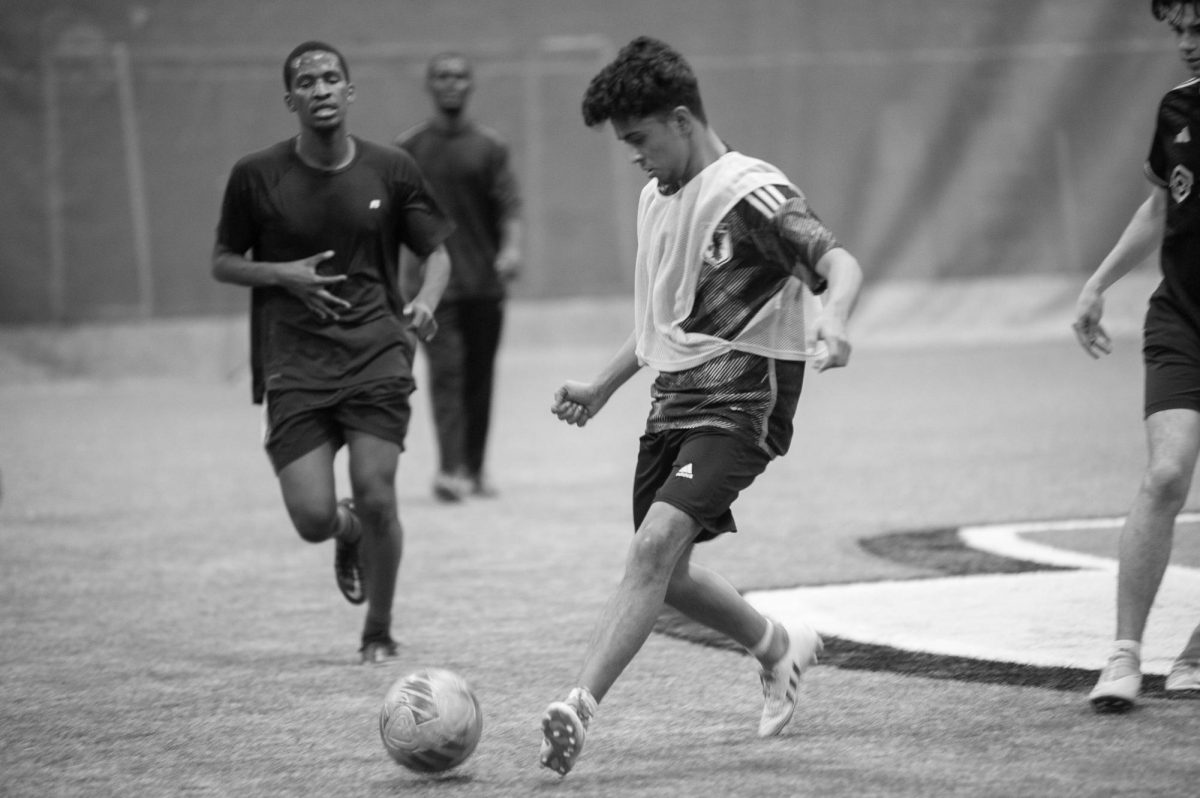
This weekend will commemorate the 50th year of ultimate Frisbee at Oberlin.
On Saturday, the alumni and students of Oberlin ultimate Frisbee will toss up the first disc of the 50th anniversary scrimmage, a mixed game spanning generations. They’ll run through the grass of North Fields again — cleats slicked with dew, jerseys sticking to their backs, the air thick with laughter and shouts. At 6:30 p.m., they’ll walk over to a barbecue at 295 N. Main St., with side dishes made from scratch and a grill that won’t quit until the stars are out. Later, one might see a crowd huddled in the unofficial Horsecow house, watching film from the 1980s and reminiscing.
Chris Ball, OC ’80, showed up to the Force Freedom home tournament a few weeks ago with a small archive in his arms: old jerseys, faded photos, and a frisbee from decades ago.
“[The frisbee] is a little broken,” College third-year Stevin Wallace said. “It’s chipped, but we’re going to tape it back.”
The weekend will see the disc repaired, and a community rejoined to celebrate a game that’s kept spinning across half a century of muddy fields, highway drives, and overflowing affection.
Planning for the reunion began last spring, when Ball reached out to the Preying Manti email list and reminded them that the 50th anniversary was approaching. From there, College fourth-years Jack Ryan, the captain of the Flying Horsecows, and Eleanor Richards, a member of the Preying Manti, embarked on a mission. Armed with a list of old Review articles, Oberlin archives, LinkedIn, and as many search engines as they could access, they reached out to alumni from years past. They ended up discovering the people who started it all.
“We have two guys, maybe three [coming] … that were on the first team in ’75,” Ryan said. “We have the first-ever woman that played on the team. Her name is Freedom Baird. She’s coming with four of her friends that also played.”
A big moment in the outreach process was when Ryan got through to Doug Powers.
Powers started an ExCo about frisbee in the fall of 1975, which went on to birth the Oberlin ultimate Frisbee team. In an email, he recalled that in January 1976, Dick Riendeau, the athletic director at the time, was contacted by one of his former students from Rensselaer Polytechnic Institute. On receiving the student’s enquiry about whether Oberlin had an ultimate Frisbee team, Riendeau referred him to Powers.
“I contacted the ExCo students and other interested folks, and we played our first game that spring,” Powers shared in an email to the Review. “I still remember my 60-yard overhand wrist flip throw-off and a full layout across the goal line from that game.”
The original teammates are now scattered across the country. Ball is in Cleveland; Lance Lubin, OC ’76, is in Florida; while John Sener, OC ’76, and Houston Miller, OC ’76, are in Virginia. Yet they left behind a legacy that set the tone for the next half-century: curious, chaotic, and devoted. Back then, before coaching videos and strategy blogs, plays were passed down by word of mouth or by alumni who’d picked up new tricks in New York summer leagues. Alumni from the 1980s reflected on how they integrated new plays.
“The hot new thing of the day was the hammer,” Steve Saideman, OC ’88, shared in an email to the Review. “We all just started throwing hammers, and we were all really bad at it.”
By the ’80s, Oberlin had become one of the Midwest’s eccentric strongholds of ultimate Frisbee. The team hosted the Oberlin Mellow Invitational Tournament, where teams came to play scoreless games. Players traveled to this pocket of northern Ohio, not to win but to revel, to slide through mud and merriment. The spirit of the game shone in the earnest, radical, and joyous community the team built.
And like all things at Oberlin, that spirit refused to stay still for long. The team changed names the way it changed plays: restlessly, gleefully, without much regard for stodgy continuity. They were first Oberlin Ultimate Frisbee, then they were the Aerobies, and then the YeoBabes, until they settled on the Flying Horsecows, a name born, according to Ryan, on the way back from a tournament in the late 1980s.
“They drove by one of the local gas stations, which was an ExxonMobil,” Ryan said. “[The ExxonMobil’s] logo was the World Pegasus, which is the — you know — flying horse. And they stole it and strapped it to the top of their van … they were still a co-ed team at that point. And so they drew on the udders.”
The name stuck, a perfect emblem for the absurd majesty of a sport that never stopped making fun of itself.
A few years later, the women’s team took on its own identity, first as the Oberlin Ohms, and, later, the Praying Manti. They wore black-and-silver skirts, T-shirts emblazoned with cleat-wearing mantises, and later, bright orange and turquoise.
“We were the hippest, coolest, buffest, most fantastic, self-assured group of women I have ever had the pleasure of knowing,” Annie Zeidman, OC ’92, said in the spring 1999 issue of the Oberlin Alumni magazine.
There were other memories, passed around as swiftly as discs on the field: the time a team stopped at a mall to buy rope to tie their gear to the roof of the car, then tumbled, clown-like, out of the car upon arrival near South Hall; the late-night rides through northern Ohio, windows down, yelling into the dark; the feeling that “we now owned Ohio” Retsu Takahashi, OC ’92, wrote.
Many alumni will be staying in the place they once called home: a weathered house at 86 N. Main St. that one can now rent as an Airbnb. To them, it will always be the Swamp, the old ultimate Frisbee house, where jerseys hung drying in doorways and music and laughter spilled into the street long after the games had ended. The 50th anniversary celebration will pay homage to that rich and unruly history by featuring a wall of discs and jerseys chronicling the decades.
The Horsecows and Manti have never been teams that just played the game. They’ve lived it. They’ve hosted sectionals, qualified for regionals and, in later years, nationals. They’ve run Flat Crawl — a three-legged race through Oberlin’s houses — and Jersey Swap, passing down jerseys from the early 2000s like relics.
“Our rep was pretty much that of a bunch of odd and talented individuals who were somehow Oberlin’s ambassadors to the world of organized athletics,” Michael Dwyer, OC ’97, wrote in the Oberlin Alumni Magazine. “Intense, individualistic, misunderstood, astonishing, sometimes goofy beyond question, often beautiful beyond comparison. Ultimate [Frisbee] and Oberlin go together like sprouts and tofu.”
On Saturday evening, as the sky turns over North Fields and the last game winds down, someone will pull the tape tighter around an old frisbee, and toss it.
Fifty years later, still airborne.