The Oberlin Heritage Center has opened “Back to School! Memories of the Oberlin Public Schools” at the Firelands Association for the Visual Arts. The exhibit presents photographs, artifacts, and oral histories that together trace how Oberlin residents have experienced their school buildings across generations. First displayed at the Heritage Center in September, the exhibit now invites a broader audience to explore the role that public education has played in shaping the community.
The project began after the consolidation of Oberlin’s elementary schools in 2021. That transition prompted several major donations of materials, many of which came from former Eastwood Elementary School Principal and Librarian Francine Toss. The process of cataloging these items lasted several years before staff felt ready to share them publicly.
Maren McKee, collections manager at the Oberlin Heritage Center, explained that this long period of work shaped the timing of the exhibit.
“We had these large donations, and it took us several years to process all of that material that included … hundreds of photographs,” she said. “So it took us several years to get through cataloging all of that and organizing it, and we just felt like now that we had mostly finished that project, this would be a great time to share that with the community.”
Much of the text displayed in the gallery comes from the Oberlin Oral History Project. Volunteers and staff began collecting interviews around the time the schools were consolidating, resulting in a wide range of memories from students, teachers, and administrators. These stories help build a fuller picture of daily life inside buildings that many residents remember but that no longer exist in the same form.
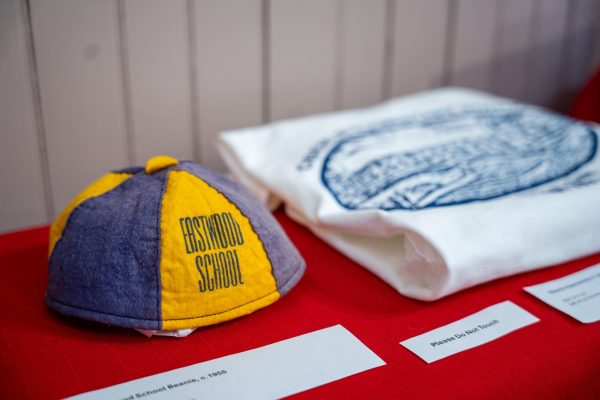
The exhibit is arranged by school building rather than by decade. Visitors move through sections on the elementary schools, Langston Middle School, and Oberlin High School. Marching band uniforms from the 1960s through the early 2000s, as well as a 1976 quilt constructed by Eastwood Elementary students, complement the photographs and written excerpts on display.
The Heritage Center hopes the exhibit reinforces how deeply education is woven into Oberlin’s identity. McKee said she hopes the exhibit highlights the value of education and the formative influence of the public schools.
“I hope this exhibit can highlight the importance of education, of teachers, how those years are very formative for people, and that it’s important to support public education,” she said.
Staff also discovered gaps in the archive as they prepared the exhibit, especially regarding Langston Middle School and non-athletic extracurriculars. They encourage community members to share photographs and materials that could strengthen the collection in the future.
As the exhibit expanded, staff found that the oral histories were not just supporting materials, but a central part of how the story of Oberlin’s schools could be told. Schultz played a key role in reviewing these interviews and shaping how they would appear in the exhibit. She said the team wanted to foreground the kinds of details that make past school environments vivid and relatable for visitors.
Executive Director of the Oberlin Heritage Center Liz Schultz worked closely on the oral history component. She said the interviews offer details that traditional records cannot capture and that these personal recollections help visitors connect with the physical spaces represented in the photographs and artifacts.
“It really brings these places to life,” she said. “It’s the stories of people remembering what the gym smelled like or how they got to school … that bring the experience alive.”
Schultz added that preserving and sharing these accounts affirms the value of everyday experience in understanding local history.
“Oral histories emphasize the point that your experiences are important,” she said. “They are what connect people together.”
The exhibit remains on view at FAVA until Feb. 1. It is open to the public during regular gallery hours, Tuesday through Sunday.