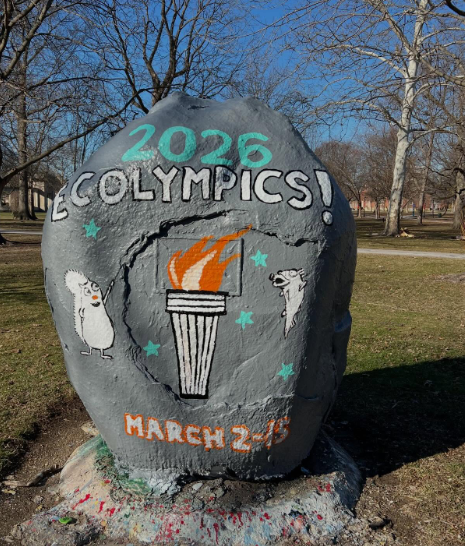
From March 2–15, Oberlin College is participating in the Ecolympics for the 15th year. The 2026 goal is to save 20,000 kilowatt-hours of electricity and 15,000 gallons of water by March 15. At the time of writing, between the City of Oberlin, Oberlin City Schools, and the College, the community has collectively saved 17,210 kilowatt-hours and 22,206 gallons –– approaching the electricity saving goal and surpassing that of water.
With a few days left in the competition, these numbers hold promise of following the pattern of the last two years, demonstrating the cumulative effect that this competition has had on the community. According to Heather Adelman, the College’s sustainability manager and one of the lead coordinators for the Ecolympics across the community, while in 2024, the Ecolympics resulted in over 2,570 gallons of water savings and 10,050 kilowatt-hours of electricity savings, the numbers skyrocketed in 2025, with a total of 26,240 gallons of water savings and 31,948 kilowatt-hours of electricity savings. Additionally, according to Adelman, they typically see resource usage staying low in the weeks following the competitions.
“It may seem like just a friendly competition, but Ecolympics creates behavior changes that last beyond the two weeks,” Adelman wrote in an email to the Review. “It is a fun and engaging opportunity to see how small personal change can make big impacts.”
This year, the Ecolympics tagline is “Local Action, Global Reaction,” which was suggested by Oberlin student Bella Ryan, who passed away last spring. She was heavily involved with the Ecolympics and dedicated her Winter Term to helping organize the Ecolympics with the Office of Environmental Sustainability.
“To me, the tagline is honoring her memory,” Environmental Studies Professor John Petersen wrote in an email to the Review. “It is obviously also a variation on the often stated, ‘Think Globally, Act Locally’ admonition and connects local and global scales, but in this case, in an action-focused way.”
Since 2006, with a five-year hiatus from 2018–2023, Oberlin has held an annual three-week competition to promote resource conservation habits. Prior to the first Ecolympics, the technology for tracking resource consumption data had been developed for the Adam Joseph Lewis Center for Environmental Studies, with major contributions from Alex Maly, OC ’03, in the initial construction of the monitoring system alongside several other community members, including Petersen. Data will be collected from numerous buildings on campus in efforts related to tracking the College’s carbon neutrality. This technology is vital in enabling Oberlin residents, including those from the College, Oberlin City Schools, and others, to understand the impact of their efforts on the town’s resource conservation.
In addition to tracking electricity and water use, Petersen has been working with College second-year Frank Kusi Appiah and College third-year Menard Simoya to initiate two high-resolution air-quality monitoring systems near the AJLC and the Service Building, powered by solar energy. They will collect data every 15 minutes to be publicly displayed alongside other data on the Environmental Dashboard, to work toward the goal of properly tracking the campus’s sources of emissions.
“Resource use can’t constantly ratchet down, though. The most important thing is [that] our students graduate and take with them lessons they learned –– many probably have no idea that they learned these lessons, but they did, nonetheless,” Petersen wrote.
Outside of the College, Oberlin Elementary School, Langston Middle School, and Oberlin High School are participating in this year’s Ecolympics once again. At the time of writing, they have collectively saved 2,237 kilowatt-hours of electricity, which is 14 percent below the baseline, with Oberlin High School shouldering the majority of these contributions. No notable change has occured around water-saving efforts.
In terms of community involvement, a range of activities have been organized in the last few weeks to encourage further learning opportunities for Oberlin students. These activities include greenhouse tours, mending and crafting workshops, and trivia at Slow Train Cafe.