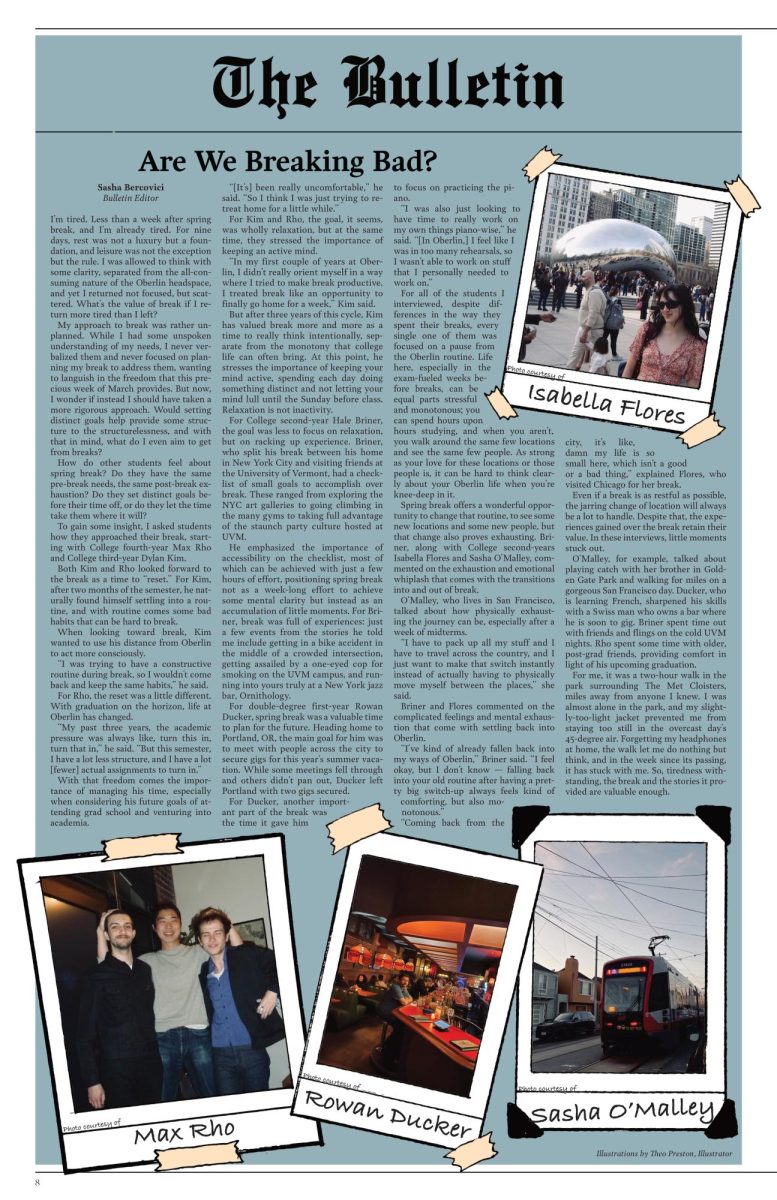
I’m tired. Less than a week after spring break, and I’m already tired. For nine days, rest was not a luxury but a foundation, and leisure was not the exception but the rule. I was allowed to think with some clarity, separated from the all-consuming nature of the Oberlin headspace, and yet I returned not focused, but scattered. What’s the value of break if I return more tired than I left?
My approach to break was rather unplanned. While I had some unspoken understanding of my needs, I never verbalized them and never focused on planning my break to address them, wanting to languish in the freedom that this precious week of March provides. But now, I wonder if instead I should have taken a more rigorous approach. Would setting distinct goals help provide some structure to the structurelessness, and with that in mind, what do I even aim to get from breaks?
How do other students feel about spring break? Do they have the same pre-break needs, the same post-break exhaustion? Do they set distinct goals before their time off, or do they let the time take them where it will?
To gain some insight, I asked students how they approached their break, starting with College fourth-year Max Rho and College third-year Dylan Kim.
Both Kim and Rho looked forward to the break as a time to “reset.” For Kim, after two months of the semester, he naturally found himself settling into a routine, and with routine comes some bad habits that can be hard to beat.
When looking toward break, Kim wanted to use his distance from Oberlin to act more consciously.
“I was trying to have a constructive routine during break, so I wouldn’t come back and keep the same habits,” he said.
For Rho, the reset was a little different. With graduation on the horizon, life at Oberlin has changed.
“My past three years, the academic pressure was always like, turn this in, turn that in,” he said. “But this semester, I have a lot less structure, and I have a lot [fewer] actual assignments to turn in.”
While that freedom is nice, it comes with the importance of managing his time, especially when considering his future goals of attending grad school and venturing into academia, something Rho has found difficult.
“[It’s] been really uncomfortable,” he said. “So I think I was just trying to retreat home for a little while.”
For Kim and Rho, the goal, it seems, was wholly relaxation, but at the same time, they stressed the importance of keeping an active mind.
“In my first couple of years at Oberlin, I didn’t really orient myself in a way where I tried to make break productive. I treated break like an opportunity to finally go home for a week.”
But after three years of this cycle, Kim has valued break more and more as a time to really think intentionally, separate from the monotony that college life can often bring. At this point, he stresses the importance of keeping your mind active, spending each day doing something distinct and not letting your mind lull until the Sunday before class. Relaxation is not inactivity.
For College second-year Hale Briner, the goal was less to focus on relaxation, and more to rack up experience. Briner, who split his break between his home in New York City and visiting friends at the University of Vermont, had a checklist of goals to accomplish over break. These ranged from exploring the NYC art galleries to climbing in the many gyms to taking full advantage of the staunch party culture hosted at UVM.
He emphasized the importance of accessibility on the checklist, with items being achieved in just a few hours of effort, positioning spring break not as a week-long effort to achieve some mental clarity but instead as an accumulation of little moments. For Briner, break was full of experiences: just a few events from the stories he told me include getting in a bike accident in the middle of a crowded intersection, getting assailed by a one-eyed cop for smoking on the UVM campus, and running into yours truly at a New York jazz bar called Ornithology.
For double-degree first-year Rowan Ducker, spring break was a valuable time to plan for the future. Heading home to Portland, OR, the main goal for him was to meet with people across the city to secure gigs for this year’s summer vacation. While some meetings fell through and others didn’t pan out, Ducker left Portland with two gigs secured.
For Ducker, another important part of the break was the time it gave him to focus on practicing piano.
“I was also just looking to have time to really work on my own things piano-wise,” he said. “[In Oberlin,] I feel like I was in too many rehearsals, so I wasn’t able to work on stuff that I personally needed to work on.”
For all of the students I interviewed, despite differences in the way they spent their breaks, every single one of them was focused on a pause from the Oberlin routine. Life here, especially in the exam-fueled weeks before breaks, can be equal parts stressful and monotonous; you can spend hours upon hours studying, and when you aren’t, you walk around the same few locations and see the same few people. As strong as your love for these locations or those people is, it can be hard to think clearly about your Oberlin life when you’re knee-deep in it.
Spring break offers a wonderful opportunity to change that routine, to see some new locations and some new people, but that change also proves exhausting. Briner, along with College second-years Isabella Flores and Sasha O’Malley, commented on the exhaustion and emotional whiplash that comes with the transitions into and out of break.
O’Malley, who lives in San Francisco, talked about how physically exhausting the journey can be, especially after a week of midterms.
“I have to pack up all my stuff and I have to travel across the country, and I just want to make that switch instantly instead of actually having to physically move myself between the places,” she said.
Briner and Flores commented on the complicated feelings and mental exhaustion that come with settling back into Oberlin.
“I’ve kind of already fallen back into my ways of Oberlin,” Briner said. “I feel okay, but I don’t know — falling back into your old routine after having a pretty big switch-up always feels kind of comforting, but also monotonous.”
Flores, who visited Chicago for her break, added that, “Coming back from the city, it’s like, damn my life is so
small here, which isn’t a good or a bad thing.”
Even if a break is as restful as possible, the jarring change of location will always be a lot to handle. Despite that, the experiences gained over the break retain their value. In these interviews, little moments stuck out.
O’Malley, for example, talked about playing catch with her brother in Golden Gate Park and walking for miles on a gorgeous San Francisco day. Ducker, who is learning French, sharpened his skills with a Swiss man who owns a bar where he is soon to gig. Briner spent time out with friends and flings on the cold UVM nights. Rho spent some time with older, post-grad friends, providing comfort in light of his upcoming graduation.
For me, it was a two-hour walk in the park surrounding The Met Cloisters, miles away from anyone I knew. I was almost alone in the park, and my slightly-too-light jacket prevented me from staying too still in the overcast day’s 45-degree air. Forgetting my headphones at home, the walk let me do nothing but think, and in the week since its passing, it has stuck with me. So, tiredness withstanding, the break and the stories it provided are valuable enough.