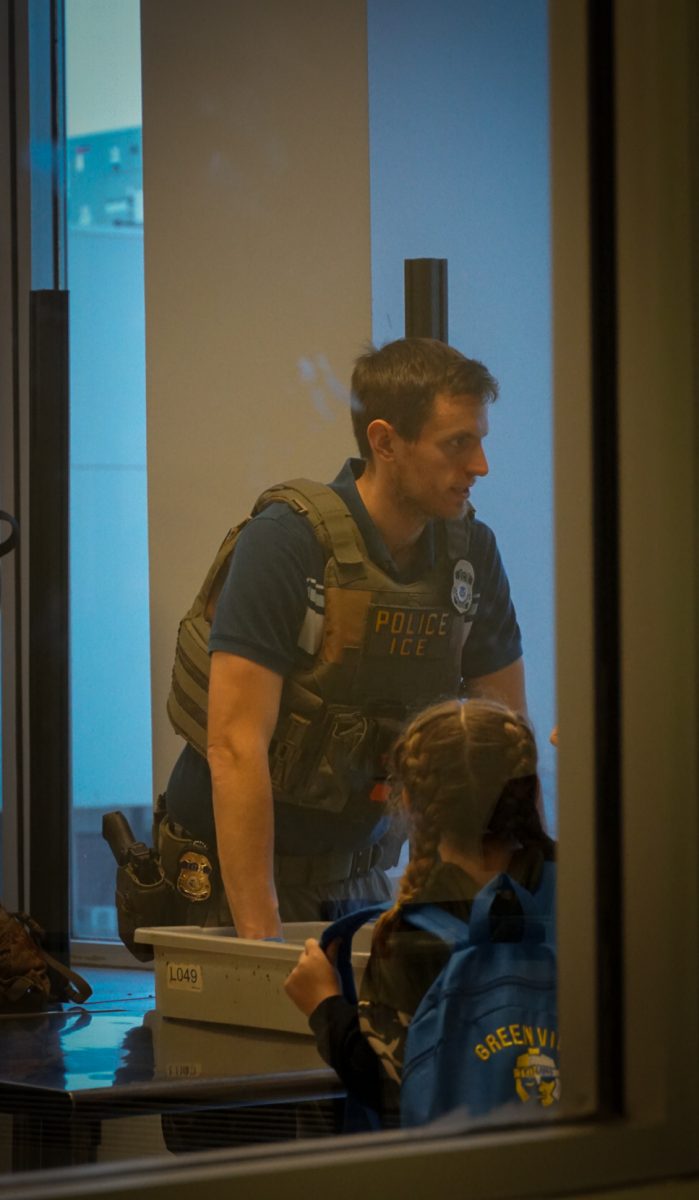
On Mar. 23, Immigration and Customs Enforcement officers were deployed under the guidance of President Donald Trump into 13 major international airports across the U.S., including Cleveland Hopkins International Airport. This deployment was legally issued in response to the long lines and disruptions caused by the partial government shutdown. TSA agents have been without pay since Feb. 14, and many have stopped attending work. The New York Times reported that more than 500 TSA employees have officially quit their jobs since the shutdown, according to the Department of Homeland Security.
Initially, ICE agents were deployed primarily to assist in simple tasks that did not require intense training. They were guarding exits and checking identification at security checkpoints. Recently, however, they have taken on a larger role.
On Monday, ICE agents at Cleveland Hopkins were assisting with the scanning of baggage through the X-ray system and with the manual search process of guest luggage. This type of TSA worker is typically required to have over 100 hours of training.
Michele Dynia, Cleveland Hopkins Airport communication specialist, stated that airport staff are not currently permitted to participate in interviews. Other airports with ICE presence have adopted similar policies.
When contacted for comment, Ohio’s ICE field office, located in Cleveland, also said that they were not authorized to discuss the subject.
Many individuals in the community have expressed concerns about whether or not ICE might make arrests while at the airport. Eleonor Ramirez, a Latina who lived in Cleveland for many years and has worked in immigration law, was planning to fly into Cleveland Hopkins this weekend, but now is apprehensive.
“Being a person of color makes me nervous to think that I could potentially be targeted at the airport even though I am a U.S. citizen,” she said.
Recently, ICE has drawn criticism and legal challenges for their rapid deportation campaign. The ACLU of Ohio filed a lawsuit against the agency earlier this year. In the suit, they reminded the court, “Before making an arrest, the agent must have ‘reason to believe’ both that (1) the individual ‘is in the United States in violation of any [immigration] law or regulation,’ and (2) the individual ‘is likely to escape before a warrant can be obtained for his arrest.’” Yet, according to the Transactional Records Access Clearinghouse, only 1.83 percent of deportation order cases were based on any criminal activity, aside from possible illegal entry.
While ICE is not stationed at airports for the sole purpose of making arrests, they are permitted to do so. President Trump said that ICE was primarily filling in gaps in TSA, however he noted that agents may take advantage of the opportunity to detain undocumented people.
“[The agents] love it, because they’re able to arrest illegals as they come into the country,” Trump said. “That’s very fertile territory, but that’s not why they’re there; they’re really there to help.”
This uncertainty over how ICE agents will behave is leading some, such as Ramirez, to rethink travel plans altogether.
“[It’s] the fact that we’re talking about the United States,” Ramirez said. “The fact that we’re like, ‘Wow, I’m in, supposedly, the best country in the world.’ And here we are questioning, ‘Am I going to be racially profiled at the airport? Maybe I shouldn’t travel.’”
Currently, Trump has set a goal of 3,000 immigration-related arrests a day. In the ACLU lawsuit, one individual described their experience in detention, where they heard agents discussing potential bonuses and gift cards they would receive to reward their arrests.
ICE warehouse purchases continue to grow to compensate for this uptick in detainees. In February, ICE purchased a warehouse in Romulus, MI, just a two-hour drive from Lorain County.
Locally, ICE surges continue to be minimal. On March 27, federal deputies took 13 men into custody for suspected labor trafficking. The individuals were then taken into federal custody by DHS. At least one of these men has been deported twice before. Aside from this, activity within the county has been nearly nonexistent.
The Trump administration claims that after the shutdown is resolved, agents will resume their usual tasks and no longer perform TSA duties. As for the state of immigration control within our country, Ramirez remains hopeful.
“These are really some challenging times,” Ramirez said. “There’s no question about it. … But I truly believe that now the American people have seen what ICE is and what they do, there will be some change, and there will be change that will affect those that have been in this country for such a long time, seeking the opportunity to adjust their status. … Because the more people care and see, the more change happens.”
The Oberlin Review will now provide biweekly updates regarding ICE presence and immigration updates. Should readers have questions or events they would like to bring to our attention, they can email the Review’s immigration correspondent Eliana Brownell at newseditors@oberlinreview.org.